Beginners Guide to Aeronautics Site Map
Beginners Guide to Aeronautics
All published pages (published or private)
All private pages only
Grid List
Includes featured images if specified and shows whether page is still private.
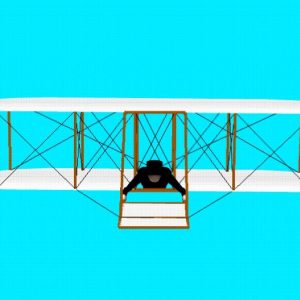
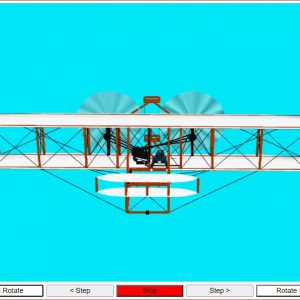
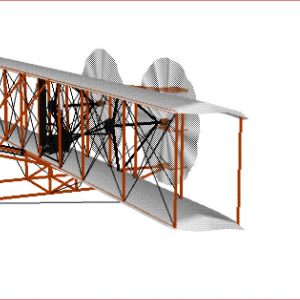
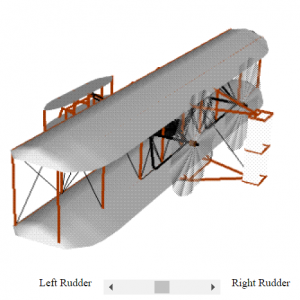
You can study the design of the 1900 aircraft by changing the view using the buttons at the bottom of this JavaScript program. This simulation shows a computer drawing of the Wright brothers’ 1900 aircraft. This aircraft was flown repeatedly at Kitty Hawk, North Carolina, during the fall of 1900, mostly as a kite but also … Read the rest ⇢
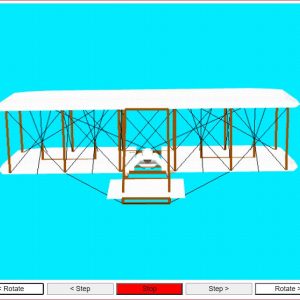
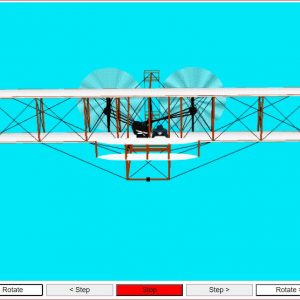
The simulation below is a computer drawing of the Wright brothers’ 1901 aircraft. This was the second unpowered aircraft built by the brothers. The aircraft was flown repeatedly at Kitty Hawk, North Carolina, during 1901 as a piloted glider and as a kite. The Wright brothers used this aircraft to further investigate the fundamentals of aerodynamics which they had begun in 1900. … Read the rest ⇢
At the end of 1901, the Wright brothers were frustrated by the flight tests of their 1900 and 1901 gliders. The aircraft were flown frequently up to 300 feet in a single glide. But neither aircraft performed as well as predicted using the design methods available to the brothers. Based on their measurements, the 1901 … Read the rest ⇢
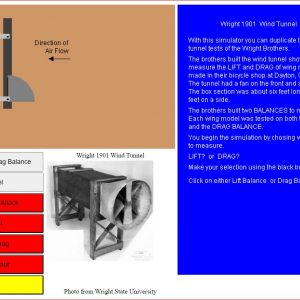
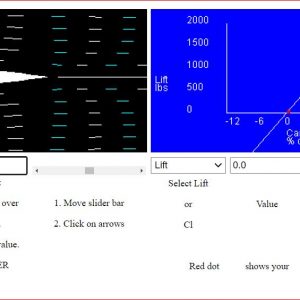
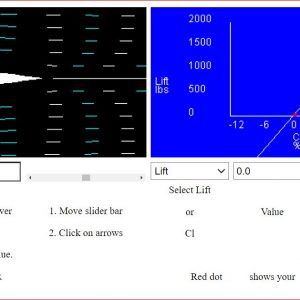
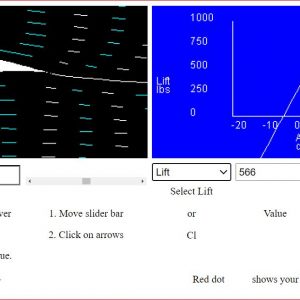
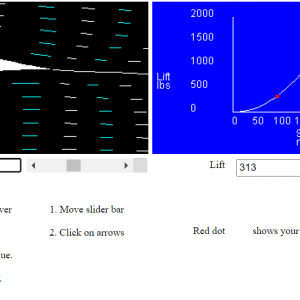
This simulation works exactly the same way that the Wright Brother’s 1901 wind tunnel worked. The layout of the simulator shows an overhead view into the tunnel test section at the upper left. You can choose to test the wing model on either the lift balance or the drag balance by clicking on the appropriate label in the view window at … Read the rest ⇢
At the end of 1901, the Wright brothers were frustrated by the flight tests of their 1900 and 1901 gliders. The aircraft were flown frequently up to 300 feet in a single glide. But neither aircraft performed as well as predicted using the design methods available to the brothers. Based on their measurements, the 1901 aircraft only developed 1/3 … Read the rest ⇢
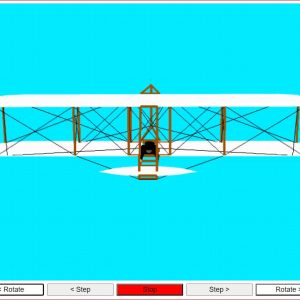
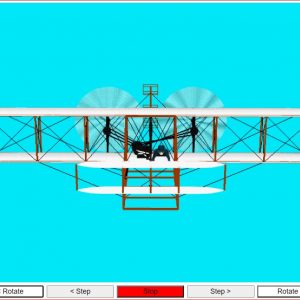
The simulation below shows a computer drawing of the Wright brothers’ 1902 aircraft. This was the third unpowered aircraft built by the brothers. The aircraft was flown repeatedly at Kitty Hawk, North Carolina, during 1902 as a piloted glider and as a kite. The Wright brothers used this aircraft to answer some of the problems encountered with the 1901 aircraft. … Read the rest ⇢
This page shows a computer drawing of the Wright brothers’ 1903 aircraft. This machine was the first piloted aircraft that was heavier than air, self-propelled and maneuverable. It was, in short, the first airplane. The forces acting on this aircraft are identical to the forces which act on any modern aircraft. The various parts of the aircraft were designed … Read the rest ⇢
This page shows a computer drawing of the Wright brothers’ 1904 aircraft. This machine was the second powered aircraft built by the brothers. The forces acting on this aircraft are identical to the forces which act on any modern aircraft. Following the successful first flights at Kitty Hawk on December 17, 1903, the brothers returned to Dayton, Ohio. On … Read the rest ⇢
This page shows a computer drawing of the Wright brothers’ 1905 aircraft. This machine was the third powered aircraft built by the brothers. In a larger sense, this aircraft was the first practical working airplane because, in its design, the brothers solved the pitching problem which had plagued the 1903 and 1904 aircraft. This aircraft was the culmination of their efforts … Read the rest ⇢
As an object moves through a fluid, the velocity of the fluid varies around the surface of the object. The variation of velocity produces a variation of pressure on the surface of the object. Integrating the pressure times the surface area around the body determines the aerodynamic force on the object. We can consider this force to act through the average … Read the rest ⇢
When two solid objects interact in a mechanical process, forces are transmitted, or applied, at the point of contact. But when a solid object interacts with a fluid, things are more difficult to describe because the fluid can change its shape. For a solid body immersed in a fluid, the “point of contact” is every point on … Read the rest ⇢
When two solid objects interact in a mechanical process, forces are transmitted, or applied, at the point of contact. But when a solid object interacts with a fluid, things are more difficult to describe because the fluid can change its shape. For a solid body immersed in a fluid, the “point of contact” is every point on … Read the rest ⇢
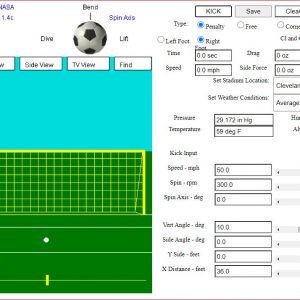
Please note: the simulation below is best viewed on a desktop computer. It may take a few minutes for the simulation to load. Many students enjoy playing and watching the game of soccer (which is known as “football” in every country in the world except the United States). With this simulation you can investigate how … Read the rest ⇢
What makes a curveball curve? What determines how far a batted ball will travel? How do weather conditions change the flight of a baseball? How does location determine if a field is a “hitters” or a “batters” park?
Ailerons can be used to generate a rolling motion for an aircraft. Ailerons are small hinged sections on the outboard portion of a wing. Ailerons usually work in opposition: as the right aileron is deflected upward, the left is deflected downward, and vice versa. This slide shows what happens when the pilot deflects the right … Read the rest ⇢
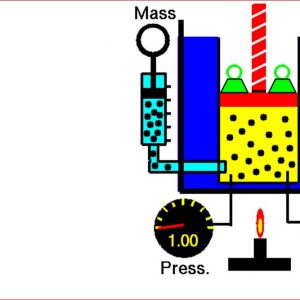
An important property of any gas is its pressure. We have some experience with air pressure that we don’t have with properties like viscosity and compressibility. We’ve heard meteorologists give the daily value of the barometric pressure of the atmosphere (29.8 inches of mercury, for example). And most of us have blown up a balloon or used a pump … Read the rest ⇢
Earth’s atmosphere is composed of air. Air is a mixture of gases, 78% nitrogen and 21% oxygen with traces of water vapor, carbon dioxide, argon, and various other components. We usually model air as a uniform (no variation or fluctuation) gas with properties that are averaged from all the individual components. Any gas has certain properties that we can detect with our senses. … Read the rest ⇢
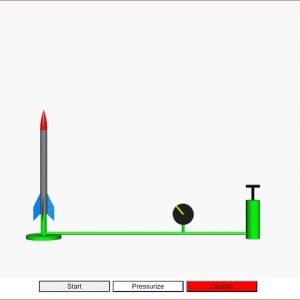
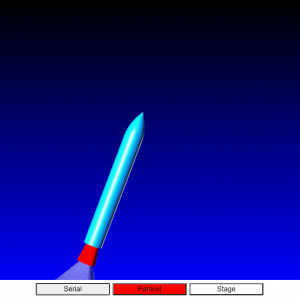
Please note: the simulation below is best viewed on a desktop computer. It may take a few minutes for the simulation to load. Above is an interactive Java simulation of the launch process. You can launch the compressed air rocket by using the buttons at the bottom of the simulator. “Start” brings the rocket back … Read the rest ⇢
An important property of any gas (including air) is temperature. We have some experience with temperature that we don’t have with properties like viscosity and compressibility. We’ve heard meteorologists give the daily value of the temperature of the atmosphere (15 degrees Celsius, for example). We know that a hot object has a high temperature, and a cold object has … Read the rest ⇢
An airplane in flight can be maneuvered by the pilot using the aerodynamic control surfaces; the elevator, rudder, or ailerons. As the control surfaces change the amount of force that each surface generates, the aircraft rotates about a point called the center of gravity. The center of gravity is the average location of the weight of the aircraft. The weight is actually distributed throughout the airplane, and … Read the rest ⇢
One of the major breakthroughs of the Wright brothers was the ability to control and maneuver their aircraft. Since we live in a three-dimensional world, it is necessary to control the attitude, or orientation, of a flying aircraft in all three dimensions. The first aircraft to achieve complete active control was the 1902 glider which … Read the rest ⇢
At the front of all of the Wright brothers’ aircraft one finds the elevators. The elevators are a pair of movable wings which are controlled by the pilot. This slide shows what happens when the pilot deflects the elevators leading edges upward. How does changing the elevator angle affect the aircraft? Let’s investigate how the elevator works by … Read the rest ⇢
Between 1900 and 1902, the Wright brothers built and tested a series of unpowered aircraft. The brothers used these aircraft to flight test some of their ideas concerning the control of aircraft, to learn the fundamentals of aerodynamics, and to learn to fly. The aircraft were flown both as kites and as piloted gliders. On this slide we show a computerized drawing … Read the rest ⇢
Between 1900 and 1902, the Wright brothers built and tested a series of unpowered aircraft. The brothers used these aircraft to flight test some of their ideas concerning the control of aircraft, to learn the fundamentals of aerodynamics, and to learn to fly. The aircraft were flown both as kites and as piloted gliders. On this slide we show a computerized … Read the rest ⇢
This simulation calculates both the lift and drag of the Joukowsky family of airfoils, elliptical foils, flat surfaces, rotating cylinders and balls. These panels are made available so that you can study the details of the conformal mapping used in the Kutta-Joukowski analysis. In the analysis, flow around a cylinder is mapped into flow around an airfoil. … Read the rest ⇢
Sir Isaac Newton first presented his three laws of motion in the “Principia Mathematica Philosophiae Naturalis” in 1686. His first law states that every object remains at rest or in uniform motion in a straight line unless compelled to change its state by the action of an external force. This is normally taken as the definition of inertia. … Read the rest ⇢
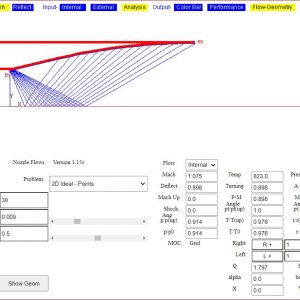
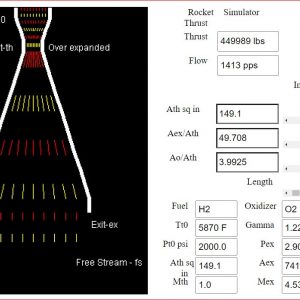
With this simulation you can investigate how an aircraft nozzle produces thrust by changing the values of different factors that affect thrust. This simulation is designed to be interactive. There are a variety of choices that you can make regarding the problem, analysis, and display of results. You make your selections by using a variety of graphical widgets. A push-button … Read the rest ⇢
Since we live in a three dimensional world, it is necessary to control the attitude or orientation of a flying aircraft in all three dimensions. In flight, any aircraft will rotate about its center of gravity, a point which is the average location of the mass of the aircraft. We can define a three dimensional coordinate system through … Read the rest ⇢
We live in world that is defined by three spatial dimensions and one time dimension. Objects can move within this domain in two ways. An object can translate, or change location, from one point to another. And an object can rotate, or change its attitude. In general, the motion of an object involves both translation and rotation. The motion of an aircraft is … Read the rest ⇢
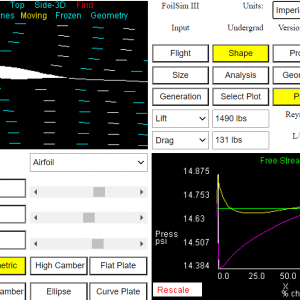
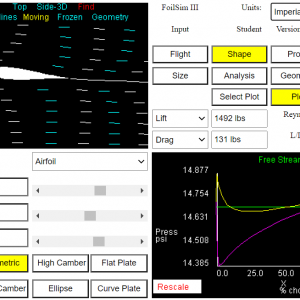
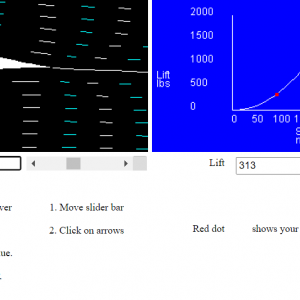
Please note: the simulation below is best viewed on a desktop computer. It may take a few minutes for the simulation to load. With this simulation you can investigate how an aircraft wing produces lift by changing the values of different factors that affect lift. This program is intended for undergraduate students and is designed to be interactive. There are … Read the rest ⇢
There are four forces that act on an aircraft in flight: lift, weight, thrust, and drag. A force is a vector quantity which means that it has both a magnitude (size) and a direction associated with it. If the size and direction of the forces acting on an object are exactly balanced, then there is no net force acting on the … Read the rest ⇢
This page shows the parts of an airplane and their functions. Airplanes are transportation devices which are designed to move people and cargo from one place to another. Airplanes come in many different shapes and sizes depending on the mission of the aircraft. The airplane shown on this slide is a turbine-powered airliner which has been chosen as a … Read the rest ⇢
Flying model rockets is a relatively safe and inexpensive way for students to learn the basics of forces and the response of vehicles to external forces. Students can also use math techniques learned in high school to determine the performance of the rocket during the flight. On this page we derive the equations which are shown on the figure to determine the maximum altitude … Read the rest ⇢
This is an interactive program in which you can investigate changes in the atmosphere and their effects on aerodynamic variables. It uses mathematical models of the standard atmosphere of the Earth and Mars. You can find the equations for the standard Earth atmosphere on this website in both English units and metric units. Similar information is available on the Martian … Read the rest ⇢
The study of model rockets, the flight of a baseball, or the “bend” of a soccer kick are excellent ways for students to learn the basics of forces and the response of an object to external forces. A ball in flight has no engine to produce continuous thrust and the resulting flight is similar to the flight of shell from a cannon, or … Read the rest ⇢
To operate the calculator, you first select the planet using the choice button at the top left. For ballistic flight, select the “Ignore Drag” option with the middle choice button. On another page we develop the equations for flight with drag. You can perform the calculations in English (Imperial) or metric units. Enter the initial velocity, … Read the rest ⇢
On Earth a baseball or a soccer ball generates a moderate amount of aerodynamic drag and the flight path is not strictly ballistic. Ballistic flight is, however, a first approximation to the flight of a ball. The actual flight equations including drag are much more complex because the drag is constantly changing throughout the flight. Drag depends on … Read the rest ⇢
A fundamental aircraft motion is a banking turn. This maneuver is used to change the aircraft heading. Using the Wright 1902 glider as an example, the turn is initiated by warping the wings to roll, or bank, the aircraft to one side. On the figure, the aircraft is banked to the right by lowering the right wing tip and raising the … Read the rest ⇢
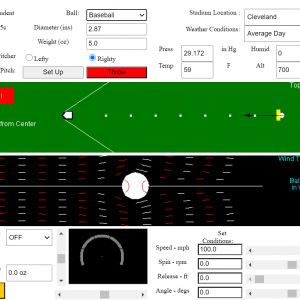
With this simulator you can investigate how a big league pitcher throws a curveball by changing the values of the factors that affect the aerodynamic forces on the ball. These are the same forces that generate the lift and drag of an aircraft wing. Please note: the simulation below is best viewed on a desktop computer. It may take a few minutes for the … Read the rest ⇢
We live in a world that is defined by three spatial dimensions and one time dimension. Objects move within this domain in two ways. An object translates, or changes location, from one point to another. And an object rotates, or changes its attitude. In general, the motion of any object involves both translation and rotation. The translations are in … Read the rest ⇢
We live in a world that is defined by three spatial dimensions and one time dimension. Objects move within this domain in two ways. An object translates, or changes location, from one point to another. And an object rotates, or changes its attitude. In general, the motion of any object involves both translation and rotation. The translations are in … Read the rest ⇢
Beginners Guide to Aeronautics Includes featured images if specified and shows whether page is still private.
Lift is the force that holds an aircraft in the air. How is lift generated? There are many explanations for the generation of lift found in encyclopedias, in basic physics textbooks, and on Web sites. Unfortunately, many of the explanations are misleading and incorrect. Theories on the generation of lift have become a source of great controversy … Read the rest ⇢
In the 1700’s, Daniel Bernoulli investigated the forces present in a moving fluid. This slide shows one of many forms of Bernoulli’s equation. The equation appears in many physics textbooks, as well as fluid mechanics and airplane textbooks. The equation states that the static pressure (p) in the flow plus one half of the density (r) … Read the rest ⇢
In the 1700s, Daniel Bernoulli investigated the forces present in a moving fluid. This slide shows one of many forms of Bernoulli’s equation. The equation appears in many physics, fluid mechanics, and airplane textbooks. The equation states that the static pressure ps in the flow plus the dynamic pressure, one half of the density rho (ρ) times the velocity V squared, is … Read the rest ⇢
The study of rockets is an excellent way for students to learn the basics of forces and the response of an object to external forces. All rockets use the thrust generated by a propulsion system to overcome the weight of the rocket. For full scale satellite launchers, the weight of the payload is only a small portion of the lift-off weight. Most of the … Read the rest ⇢
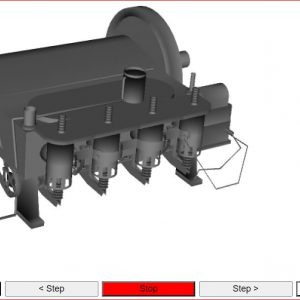
On this page we present some technical definitions that are used to describe an internal combustion engine. The figure shows a computer animation of one cylinder of the Wright brothers’ 1903 aircraft engine. A small section of the crankshaft is shown in red, the piston and piston rod are shown in gray, and the cylinder which contains the piston … Read the rest ⇢
As an object moves through a fluid, or as a fluid moves past an object, the molecules of the fluid near the object are disturbed and move around the object. Aerodynamic forces are generated between the fluid and the object. The magnitude of these forces depends on the shape of the object, the speed of … Read the rest ⇢
Air is a gas which has various properties which we can observe with our senses, including the gas pressure (p), temperature, mass, and the volume (V) which contains the gas. Careful, scientific observation has determined that these variables are related to one another, and the values of these properties determine the state of the gas. In the mid 1600’s, Robert Boyle studied the relationship … Read the rest ⇢
The center of gravity is a geometric property of any object. The center of gravity is the average location of the weight of an object. We can completely describe the motion of any object through space in terms of the translation of the center of gravity of the object from one place to another, and the rotation of the object about its center of gravity … Read the rest ⇢
As an object moves through a fluid, the velocity of the fluid varies around the surface of the object. The variation of velocity produces a variation of pressure on the surface of the object as shown by the the thin red lines on the figure. Integrating the pressure times the surface area around the body determines the aerodynamic force on the … Read the rest ⇢
As an object moves through a gas, the gas molecules are deflected around the object. If the speed of the object is much less than the speed of sound of the gas, the density of the gas remains constant, and the flow of gas can be described by conserving momentum and energy. As the speed of the object … Read the rest ⇢
Air is a gas which has various properties that we can observe with our senses, including the gas pressure, temperature (T), mass, and the volume (V) that contains the gas. Careful, scientific observation has determined that these variables are related to one another and that the values of these properties determine the state of the gas. The relationship between temperature and volume, at a … Read the rest ⇢
This is a computer drawing of a combustion chamber of the Wright brothers’ 1903 aircraft engine. This engine powered the first, heavier than air, self-propelled, maneuverable, piloted aircraft; the Wright 1903 Flyer, flown at Kitty Hawk, North Carolina, in December 1903. To generate thrust for their aircraft, the brothers used twin, counter-rotating propellers at the rear … Read the rest ⇢
This is a computer drawing of one cylinder of the Wright brothers’ 1903 aircraft engine. This engine powered the first, heavier than air, self-propelled, maneuverable, piloted aircraft; the Wright 1903 Flyer. The engine consisted of four cylinders like the one shown above, with each piston connected to a common crankshaft which turns the propellers to produce thrust. The brothers’ design is very simple by … Read the rest ⇢
Thermodynamics is a branch of physics which deals with the energy and work of a system. Thermodynamics deals only with the large scale response of a system which we can observe and measure in experiments. Like the Wright brothers, we are most interested in thermodynamics for the role it plays in engine design. On this page we … Read the rest ⇢
This is a computer drawing of one cylinder of the Wright brothers’ 1903 aircraft engine. This engine powered the first, heavier than air, self-propelled, maneuverable, piloted aircraft; the Wright 1903 Flyer. The engine consisted of four cylinders like the one shown above, with each piston connected to a common crankshaft which turns the propellers to produce thrust. The brothers’ design is very simple by … Read the rest ⇢
Computed Conditions – Geometry Velocity Distribution on Canard Velocity Distribution on Lower Wing Velocity Distribution on Upper Wing Pressure Distribution on Canard Pressure Distribution on Lower Wing Distribution on Upper Wing
Computed Conditions – Geometry Velocity Distribution on Canard Velocity Distribution on Lower Wing Velocity Distribution on Upper Wing Pressure Distribution on CanardPressure Distribution on Lower Wing Distribution on Upper Wing
Computed Conditions – Geometry Velocity Distribution on Canard Velocity Distribution on Lower Wing Velocity Distribution on Upper Wing Pressure Distribution on Canard Pressure Distribution on Lower Wing Distribution on Upper Wing
Engineers make mathematical predictions of the performance of any new aircraft as part of the design process. These predictions use the best data and mathematical techniques which are available to the engineer. As the Wright brothers were designing their first aircraft, the basic principles of aerodynamics were being discovered. The brothers made mathematical predictions of the performance of their … Read the rest ⇢
Conformal mapping is a mathematical technique used to convert (or map) one mathematical problem and solution into another. It involves the study of complex variables. Complex variables are combinations of real and imaginary numbers, which is taught in secondary schools. The use of complex variables to perform a conformal mapping is taught in college. Under some very restrictive conditions, we can … Read the rest ⇢
The conservation of energy is a fundamental concept of physics along with the conservation of mass and the conservation of momentum. Within some problem domain, the amount of energy remains constant, and energy is neither created nor destroyed. Energy can be converted from one form to another (potential energy can be converted to kinetic energy) … Read the rest ⇢
The conservation of mass is a fundamental concept of physics along with the conservation of energy and the conservation of momentum. Within some problem domain, the amount of mass remains constant–mass is neither created nor destroyed. This seems quite obvious, as long as we are not talking about black holes or very exotic physics problems. … Read the rest ⇢
The conservation of momentum is a fundamental concept of physics along with the conservation of energy and the conservation of mass. Momentum is defined to be the mass of an object multiplied by the velocity of the object. The conservation of momentum states that, within some problem domain, the amount of momentum remains constant; momentum … Read the rest ⇢
This is a computer drawing of the cooling system of the Wright brothers’ 1903 aircraft engine. This engine powered the first, heavier than air, self-propelled, maneuverable, piloted aircraft; the Wright 1903 Flyer at Kitty Hawk, North Carolina, in December, 1903. To generate thrust for their aircraft, the brothers used twin, counter-rotating propellers at the rear of the aircraft. To turn the propellers, the brothers … Read the rest ⇢
This is a computer drawing of the crankcase of the Wright brothers’ 1903 aircraft engine. This engine powered the first, heavier than air, self-propelled, maneuverable, piloted aircraft; the Wright 1903 Flyer, flown at Kitty Hawk, North Carolina, in December 1903. To generate thrust for their aircraft, the brothers used twin, counter-rotating propellers at the rear of … Read the rest ⇢
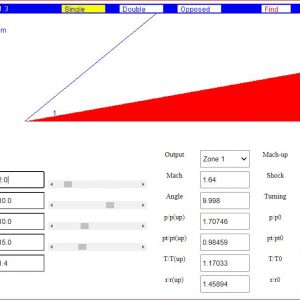
When an object moves faster than the speed of sound, and there is an abrupt decrease in the flow area, shock waves are generated. Shock waves are very thin regions in the gas where the gas properties change by a large amount. In many flow problems multiple shocks are present. The shocks may intersect with each other and with the … Read the rest ⇢
There are four forces that act on an aircraft in flight: lift, weight, thrust, and drag. From Newton’s first law of motion we know that an object at rest will stay at rest, and an object in motion (constant velocity) will stay in motion unless acted on by an external force. If there is no net external force, the … Read the rest ⇢
With this simulation you can investigate how a big league pitcher throws a curveball by changing the values of the factors that affect the aerodynamic forces on the ball. These are the same forces that generate the lift of an aircraft wing. Please note: the simulation below is best viewed on a desktop computer. It may take a few minutes for … Read the rest ⇢
All that is necessary to create lift is to turn a flow of air. The airfoil of a wing turns a flow, but so does a spinning baseball. The details of how the force is generated are fairly complex, but the magnitude of the force F depends on the radius of the ball b, the spin of the ball s, the velocity V of the pitch, the … Read the rest ⇢
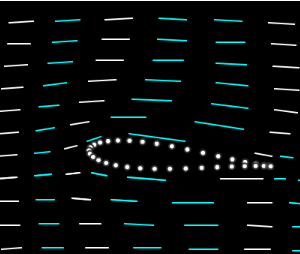
An important concept in the study of aerodynamics concerns the idea of streamlines. A streamline is a path traced out by a massless particle as it moves with the flow. It is easiest to visualize a streamline if we move along with the body (as opposed to moving with the flow). The figure above shows the computed … Read the rest ⇢
Aerodynamic forces are generated whenever an object moves through a liquid or gas. From Newton’s second law of motion, the aerodynamic forces on the body are directly related to the change in momentum of the fluid with time. The fluid momentum is equal to the mass times the velocity of the fluid. Since the fluid is moving, defining the mass … Read the rest ⇢
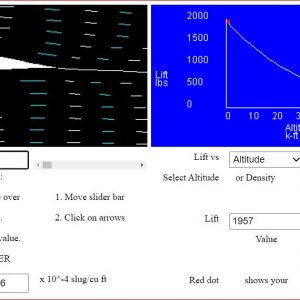
Let’s investigate the dependence of lift on density using a Java simulator. Please note: the simulation below is best viewed on a desktop computer. It may take a few minutes for the simulation to load. Lift is created by deflecting a moving fluid (liquid or gas), and drag is generated on a body in a wide variety of … Read the rest ⇢
Flying model rockets is a relatively safe and inexpensive way for students to learn the basics of forces and the response of vehicles to external forces. Students can also use math techniques learned in high school to determine the performance of the rocket during the flight. On this slide we show a simple way to determine the maximum altitude the rocket reaches … Read the rest ⇢
Weight is the force generated by the gravitational attraction of the earth on the airplane. Each part of the aircraft has a unique weight and mass, and for some problems it is important to know the distribution. But for total aircraft maneuvering, we only need to be concerned with the total weight and the location of the center of gravity. The center of … Read the rest ⇢
There are many factors which influence the amount of aerodynamic lift which a body generates. Lift depends on the shape, size, inclination, and flow conditions of the air passing the object. For a three dimensional wing, there is an additional effect on lift, called downwash, which will be discussed on this page. For a lifting wing, the air pressure on the top of the wing is lower than … Read the rest ⇢
Drag is the aerodynamic force that opposes an aircraft’s motion through the air. Drag is generated by every part of the airplane, even the engines. How is drag generated? Drag is a mechanical force. It is generated by the interaction and contact of a solid body with a fluid (liquid or gas). It is not generated by a force … Read the rest ⇢
During the fall of 1901, the brothers began to question the aerodynamic data on which they were basing their aircraft designs. They decided to conduct a series of wind tunnel tests to verify the results they were experiencing in flight. They would measure the aerodynamic lift and drag on small models of their wing designs using a wind tunnel in their bicycle shop in Dayton, Ohio. They built … Read the rest ⇢
The drag coefficient is a number that engineers use to model all of the complex dependencies of shape, inclination, and flow conditions on aircraft and rocket drag. This equation is simply a rearrangement of the drag equation where we solve for the drag coefficient in terms of the other variables. The drag coefficient Cd is equal to the drag D divided by the quantity: density ρ times half the velocity V squared times the … Read the rest ⇢
Drag depends on the density of the air, the square of the velocity, the air’s viscosity and compressibility, the size and shape of the body, and the body’s inclination to the flow. In general, the dependence on body shape, inclination, air viscosity, and compressibility is very complex. One way to deal with complex dependencies is to characterize the dependence by a single variable. For drag, this variable is called … Read the rest ⇢
Between 1900 and 1905, the Wright brothers designed and built three unpowered gliders and three powered aircraft. In the design of each aircraft, the brothers tried to maximize the lift to drag ratio because high lift and low drag gives the best airplane performance. How did they predict the lift and drag of their design? The Wright brothers were bicycle mechanics and designers and they had … Read the rest ⇢
Aerodynamicists use wind tunnels to test models of proposed aircraft and engine components. During a test, the model is placed in the test section of the tunnel and air is made to flow past the model. Various types of instrumentation are used to determine the forces on the model. The most basic type of instrument is the force balance. Force balances are used to … Read the rest ⇢
The aerodynamic drag on an object depends on several factors, including the shape, size, inclination, and flow conditions. All of these factors are related to the value of the drag through the drag equation. \(\LARGE D=\frac{1}{2}C_dρV^2A\) Where D is equal to the drag, ρ is the air density, V is the velocity, A is a reference area, and Cd is the drag coefficient. The drag coefficient is a dimensionless number that characterizes all of the complex factors that … Read the rest ⇢
As an object moves through the air, the air resists the motion of the object. This resistance is called aerodynamic drag. Drag is present on all objects moving through the air from airliners to baseballs. Drag is the component of the aerodynamic force that is aligned and opposite to the flight direction. On this page we will discuss some of the … Read the rest ⇢
This slide shows the balance of forces on a descending Wright 1902 glider. The flight path of the glider is along the thin black line, which falls to the left. The flight path intersects the horizontal, thin, red ground line at an angle “a” called the glide angle. There are three forces acting on the glider; lift, weight, and drag. … Read the rest ⇢
With this simulator you can investigate how an object falls through the air by changing the values of different design variables. Please note: the simulation below is best viewed on a desktop computer. It may take a few minutes for the simulation to load. DropSim considers the single problem of an object falling under the influence … Read the rest ⇢
An important property of any gas is its pressure. Because understanding what pressure is and how it works is so fundamental to the understanding of aerodynamics and propulsion, we are including several slides on pressure in the Beginner’s Guide. There are two ways to look at pressure: (1) the small-scale action of individual air molecules … Read the rest ⇢
An important property of any gas is its pressure. Because understanding what pressure is and how it works is so fundamental to the understanding of rocketry, we are including several slides on pressure in the Beginner’s Guide. There are two ways to look at pressure: (1) the small scale action of individual air molecules or (2) the large scale … Read the rest ⇢
The Earth is our home planet. It is the third planet from the Sun and orbits the Sun at an average distance of approximately 93 million miles (149 million km). The Earth rotates on its axis, completing one revolution every 24 hours with respect to the Sun (23 hrs. 56 min with respect to the … Read the rest ⇢
The Earth’s atmosphere is an extremely thin sheet of air extending from the surface of the Earth to the edge of space, about 60 miles above the surface of the Earth. If the Earth were the size of a basketball, a tightly held pillowcase would represent the thickness of the atmosphere. Gravity holds the atmosphere to the Earth’s surface. Within the … Read the rest ⇢
The Earth’s atmosphere is an extremely thin sheet of air extending from the surface of the Earth to the edge of space. If the Earth were the size of a basketball, a tightly held pillowcase would represent the thickness of the atmosphere. Gravity holds the atmosphere to the Earth’s surface. Within the atmosphere, very complex chemical, thermodynamic, and fluid dynamics effects occur. The atmosphere … Read the rest ⇢
The amount of lift generated by an object depends on the size of the object. Lift is an aerodynamic force and therefore depends on the pressure variation of the air around the body as it moves through the air. The total aerodynamic force is equal to the pressure times the surface area around the body. Lift is the component of this force perpendicular to the … Read the rest ⇢
As an aircraft moves through the air, the wing is inclined to the flight direction at some angle. The angle between the chord line of the airfoil and the flight direction is called the angle of attack. Angle of attack has a large effect on the lift generated by a wing. During takes off, the pilot applies as much thrust as possible to … Read the rest ⇢
The drag coefficient is a number which aerodynamicists use to model all of the complex dependencies of drag on shape, inclination, and some flow conditions. The drag coefficient (Cd) is equal to the drag (D) divided by the quantity: density (r) times reference area (A) times one half of the velocity (V) squared. This slide shows some typical values of the drag coefficient for a variety of shapes. The values shown … Read the rest ⇢
The amount of lift generated by an object depends on how much the flow is turned, which depends on the shape of the object. In general, the lift is a very complex function of the shape. Aerodynamicists model the shape effect by a lift coefficient which is normally determined through wind tunnel testing. For some simple shapes, we can develop mathematical equations to … Read the rest ⇢
The amount of lift generated by a wing depends on how much the flow is turned, which depends on the shape of the object. The lift is, in general, a very complex function of the shape. Aerodynamicists model the effect by a lift coefficient which is normally determined through wind tunnel testing. The Wright brothers built a wind tunnel in 1901 to determine … Read the rest ⇢
Lift is created by deflecting a flow of air and drag is generated on a body in a wide variety of ways. From Newton’s second law of motion, the aerodynamic forces on the body (lift and drag) are directly related to the change in momentum of the fluid with time. The fluid momentum is equal to the mass times the velocity of the fluid. Since the … Read the rest ⇢
Following the liftoff of a model rocket, it often turns into the wind. This maneuver is called weathercocking and it is caused by aerodynamic forces on the rocket. Wind striking the side of the rocket generates a side force which acts through the center of pressure. For stability reasons, the center of pressure is located … Read the rest ⇢
This is a computer drawing of the electrical system of the Wright brothers’ 1903 aircraft engine. This engine powered the first, heavier than air, self-propelled, maneuverable, piloted aircraft; the Wright 1903 Flyer at Kitty Hawk, North Carolina, in December, 1903. To generate thrust for their aircraft, the brothers used twin, counter-rotating propellers at the rear of the aircraft. To turn the propellers, the brothers … Read the rest ⇢
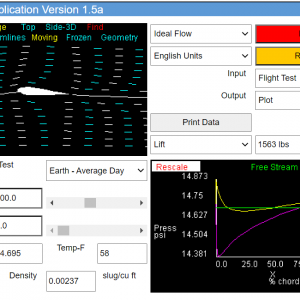
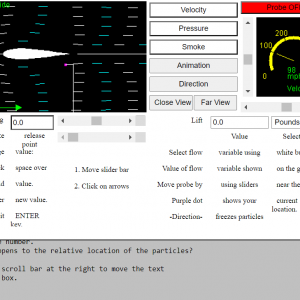
With this simulator you can investigate how an airplane wing produces lift and drag. You can change the values of different factors that determine lift and drag by using the colored buttons located below the picture of the wing. The value of the lift and drag are presented by the thermometer gages on the lower right. There are several … Read the rest ⇢
This is an animated computer drawing of the Wright brothers’ 1903 aircraft engine. This machine powered the first, heavier than air, self-propelled, maneuverable, piloted aircraft; the Wright 1903 Flyer, flown at Kitty Hawk, North Carolina, in December 1903. To generate thrust for their aircraft, the brothers used twin, counter-rotating propellers at the rear of the … Read the rest ⇢
This is an animated computer drawing of one cylinder of the Wright brothers’ 1903 aircraft engine. This engine powered the first, heavier than air, self-propelled, maneuverable, piloted aircraft; the Wright 1903 Flyer. The engine consisted of four cylinders like the one shown above, with each piston connected to a common crankshaft. The crankshaft was connected to two counter-rotating propellers which produced the thrust necessary … Read the rest ⇢
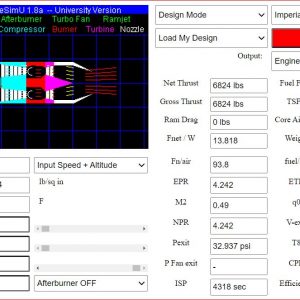
With this simulator, you can investigate how a turbine (or jet) engine produces thrust by changing the values of different engine parameters. Please note: the simulation below is best viewed on a desktop computer. It may take a few minutes for the simulation to load. This program is designed to be interactive. There are several … Read the rest ⇢
This is a computer drawing of the Wright brothers’ 1903 aircraft engine. This machine powered the first, heavier than air, self-propelled, maneuverable, piloted aircraft; the Wright 1903 Flyer. The brothers’ design is very simple by today’s standards, so it is a good engine for students to study and learn the fundamentals of engines and their … Read the rest ⇢
Thermodynamics is a branch of physics which deals with the energy and work of a system. It was born in the 19th century as scientists were first discovering how to build and operate steam engines. Thermodynamics deals only with the large-scale response of a system which we can observe and measure in experiments. The basic … Read the rest ⇢
Thermodynamics is a branch of physics which deals with the energy and work of a system. Thermodynamics deals only with the large scale response of a system which we can observe and measure in experiments. Like the Wright brothers, we are most interested in thermodynamics for the role it plays in engine design. The state of a … Read the rest ⇢
Thermodynamics is a branch of physics which deals with the energy and work of a system. Thermodynamics deals only with the large scale response of a system which we can observe and measure in experiments. In rocket science, we are most interested in thermodynamics in the study of propulsion systems and understanding high speed flows. The state of a gas is defined by … Read the rest ⇢
Thermodynamics is a branch of physics that deals with the energy and work of a system. In rocket science, we are most interested in thermodynamics in the study of propulsion systems and understanding high speed flows. The first law of thermodynamics indicates that the total energy of a system is conserved. Total energy includes the potential and kinetic energy, the work done by the … Read the rest ⇢
Entropy, like temperature and pressure, can be explained on both a macro scale and a micro scale. Since thermodynamics deals only with the macro scale, the change in entropy \(\bf \Delta S\) is defined here to be the heat transfer \(\bf \Delta Q\) into the system divided by the temperature T: \(\LARGE \Delta S=\frac{\Delta Q}{T}\) During … Read the rest ⇢
Thermodynamics is a branch of physics that deals with the energy and work of a system. As aerodynamicists, we are most interested in thermodynamics in the study of propulsion systems. The first law of thermodynamics indicates that the total energy of a system is conserved. This includes the potential and kinetic energy, the work done by the system, and the transfer of heat through the … Read the rest ⇢
There are many theories of how lift is generated. Unfortunately, many of the theories found in encyclopedias, on web sites, and even in some textbooks are incorrect, causing unnecessary confusion for students. The theory described on this slide is one of the most widely circulated, incorrect explanations. The theory can be labeled the “Longer Path” theory, or the … Read the rest ⇢
Air is a gas which has various properties that we can observe with our senses, including the gas pressure (p), temperature (T), mass (m), and volume (V) that contains the gas. Careful, scientific observation has determined that these variables are related to one another, and the values of these properties determine the state of the gas. If we fix any two of the properties … Read the rest ⇢
Gases have various properties that we can observe with our senses, including the gas pressure p, temperature T, mass m, and volume V that contains the gas. Careful, scientific observation has determined that these variables are related to one another, and the values of these properties determine the state of the gas. If we fix any two of the properties, we can determine the nature … Read the rest ⇢
In cruising flight, an airplane can sustain a constant speed and level flight in which the forces are all in equilibrium. As shown on the slide, the weight is balanced by the lift, and the drag is balanced by the thrust. However, if the forces become unbalanced, the aircraft will move in the direction of the greater force. We can compute the acceleration (a), velocity (V), and final displacement … Read the rest ⇢
A very basic concept when dealing with either forces or torques (moments) is the idea of equilibrium or balance. Forces and torques are vector quantities which means that they have both a magnitude and a direction associated with them. Two forces with the same magnitude but different directions are not equal forces. In general, an object can be acted on by several different forces … Read the rest ⇢
On this slide we have two versions of the Euler Equations which describe how the velocity, pressure and density of a moving fluid are related. The equations are named in honor of Leonard Euler, who was a student with Daniel Bernoulli, and studied various fluid dynamics problems in the mid-1700’s. The equations are a set of coupled differential equations and they can be … Read the rest ⇢
The propulsion system of an aircraft must perform two important roles: During cruise, the engine must provide enough thrust, to balance the aircraft drag while using as little fuel as possible. During takeoff and maneuvers, the engine must provide additional thrust to accelerate the aircraft. Thrust T and drag D are forces and are vector quantities which have a magnitude and a direction associated with them. The thrust minus the drag … Read the rest ⇢
This is a computer drawing of one cylinder of the Wright brothers’ 1903 aircraft engine. This engine powered the first, heavier than air, self-propelled, maneuverable, piloted aircraft; the Wright 1903 Flyer. The engine consisted of four cylinders like the one shown above, with each piston connected to a common crankshaft which turns the propellers to produce thrust. The brothers’ design is very simple by … Read the rest ⇢
When a solid body is moved through a fluid (gas or liquid), the fluid resists the motion. The object is subjected to an aerodynamic force in a direction opposed to the motion which we call drag. There are many factors that affect aerodynamic forces. We can group these factors into (a) those associated with the object, (b) those … Read the rest ⇢
When a solid body is moved through a fluid (gas or liquid), the fluid resists the motion. The object is subjected to an aerodynamic force in a direction opposed to the motion which we call drag. As with aircraft lift, there are many factors that affect drag. We can group these factors into (a) those associated with the object, (b) those … Read the rest ⇢
All that is necessary to create lift is to turn a flow of air. An aerodynamic, curved airfoil will turn a flow. But so will a simple flat plate, if it is inclined to the flow. The fuselage of an airplane will also generate lift if it is inclined to the flow. For that matter, an automobile body also … Read the rest ⇢
An object that is falling through the atmosphere is subjected to two external forces. The first force is the gravitational force, expressed as the weight of the object, and the second force is the aerodynamic drag of the object. The weight equation defines the weight W to be equal to the mass m of the object times the gravitational acceleration g: \(\LARGE W=m\cdot g\) The value of g is 9.8 meters … Read the rest ⇢
The conservation of energy is a fundamental concept of physics along with the conservation of mass and the conservation of momentum. Within some problem domain, the amount of energy remains constant and energy is neither created nor destroyed. Energy can be converted from one form to another (potential energy can be converted to kinetic energy) … Read the rest ⇢
Thermodynamics is a branch of physics which deals with the energy and work of a system. Thermodynamics deals only with the large scale response of a system which we can observe and measure in experiments. An understanding of thermodynamics was very important for the Wright brothers in the design of their 1903 engine. In our observations of … Read the rest ⇢
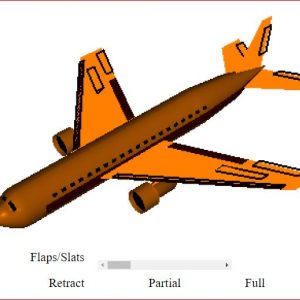
Let’s investigate how the flaps and slats work by using a JavaScript simulator. Please note: the simulation below is best viewed on a desktop computer. It may take a few minutes for the simulation to load. The amount of lift generated by a wing depends on the shape of the airfoil, the wing area, and the aircraft velocity. During takeoff … Read the rest ⇢
A ball in flight has no engine to produce thrust, so the resulting flight is similar to the flight of shell from a cannon, or a bullet from a gun. This type of flight is called ballistic flight and assumes that weight is the only force acting on the ball. In reality, a baseball or a soccer ball in … Read the rest ⇢
Flying model rockets is a relatively safe and inexpensive way for students to learn the basics of forces and the response of vehicles to external forces. Like an airplane in flight, a model rocket is subjected to the forces of weight, thrust, and the aerodynamic forces, lift and drag. The relative magnitude and direction of the forces determines the flight trajectory of the rocket. On this … Read the rest ⇢
Flying model rockets is a relatively safe and inexpensive way for students to learn the basics of forces and the response of a vehicle to external forces. A model rocket is subjected to four forces in flight: weight, thrust, and the aerodynamic forces, lift and drag. The relative magnitude and direction of the forces determines … Read the rest ⇢
Flying model rockets is a relatively safe and inexpensive way for students to learn the basics of forces and the response of a vehicle to external forces. In flight a model rocket is subjected to four forces; weight, thrust, and the aerodynamic forces, lift and drag. The relative magnitude and direction of the forces determines the flight trajectory of the rocket. On this page we show the … Read the rest ⇢
The study of rockets is an excellent way for students to learn the basics of forces and the response of an object to external forces. All rockets use the thrust generated by a propulsion system to overcome the weight of the rocket. The aerodynamic drag and lift are important forces acting on the toy rockets, … Read the rest ⇢
As a wing moves through the air, the wing is inclined to the flight direction at some angle. The angle between the chord line and the flight direction is called the angle of attack and has a large effect on the lift generated by a wing. When an airplane takes off, the pilot applies as much thrust as possible to make the airplane … Read the rest ⇢
Below is a table of calculations made using the Hit Modeler Interactive Simulator. You can use these results to check your version of the program. Each case uses a 100 mph hit angled at 45 degrees which is typical for a big league ball player. The first case was run by setting the drag coefficient … Read the rest ⇢
There are four forces that act on an aircraft in flight: lift, weight, thrust, and drag. The motion of the aircraft through the air depends on the relative size of the various forces and the orientation of the aircraft. For an aircraft in cruise, the four forces are balanced, and the aircraft moves at a constant velocity and altitude. On this slide, we consider the … Read the rest ⇢
When a baseball is thrown or hit, the resulting motion of the ball is determined by Newton’s laws of motion. From Newton’s first law, we know that the moving ball will stay in motion in a straight line unless acted on by external forces. A force, which is a vector quantity, may be thought of as a push or … Read the rest ⇢
A force may be thought of as a push or pull in a specific direction. This slide shows the forces that act on the Wright 1900 aircraft when flown as a kite. You can compare these forces to the forces on the aircraft when flown as a piloted glider and you will note only a few differences. There are also a few differences from … Read the rest ⇢
The study of rockets is an excellent way for students to learn the basics of forces and the response of an object to external forces. The motion of an object in response to an external force was first accurately described over 300 years ago by Sir Isaac Newton, using his three laws of motion. Engineers … Read the rest ⇢
A force may be thought of as a push or pull in a specific direction. A force is a vector quantity so a force has both a magnitude and a direction. When describing forces, we have to specify both the magnitude and the direction. This slide shows the forces that act on an airplane in flight. Weight is a force that is always … Read the rest ⇢
A force may be thought of as a push or pull in a specific direction. This slide shows the forces that act on the Wright airplane in flight. Weight is a force that is always directed toward the center of the earth. The magnitude of the force depends on the mass of all the airplane parts, plus the amount of fuel, plus … Read the rest ⇢
An object that falls through a vacuum is subjected to only one external force, the gravitational force, expressed as the weight of the object. The weight equation defines the weight W to be equal to the mass of the object m times the gravitational acceleration g: \(\LARGE W=m\cdot g\) the value of g is 9.8 meters per square second on the surface of the earth. The gravitational acceleration g decreases with … Read the rest ⇢
An object that falls through a vacuum is subjected to only one external force, the gravitational force, expressed as the weight of the object. The weight equation defines the weight W to be equal to the mass of the object m times the gravitational acceleration g: \(\LARGE W=mg\) The value of g is 9.8 meters per square second (32.2 feet per square second) on the surface of … Read the rest ⇢
This is a computer drawing of the fuel system of the Wright brothers’ 1903 aircraft engine. This engine powered the first, heavier than air, self-propelled, maneuverable, piloted aircraft; the Wright 1903 Flyer at Kitty Hawk, North Carolina, in December, 1903. To generate thrust for their aircraft, the brothers used twin, counter-rotating propellers at the rear of the aircraft. To turn the propellers, the brothers … Read the rest ⇢
The scientists and engineers of tomorrow are working with today’s engineers and technicians to retrace the steps of the Wright Brothers. A full scale replica of the Wright’s 1900 aircraft has been built in a joint effort between the Orono Middle School of Orono, Maine, and the NASA Glenn Research Center in Cleveland, Ohio. The … Read the rest ⇢
Flying model rockets is a relatively safe and inexpensive way for students to learn the basics of forces and motion. There are many different types of model rockets and one of the first and simplest type of rocket that a student encounters is the bottle rocket. We have an entire section of the Beginner’s Guide to Rockets, devoted to the science and math of … Read the rest ⇢
A glider is a special kind of aircraft that has no engine. In flight, a glider has three forces acting on it as compared to the four forces that act on a powered aircraft. Both types of aircraft are subjected to the forces of lift, drag, and weight. The powered aircraft has an engine that generates thrust, while the glider has no thrust. There are many different … Read the rest ⇢
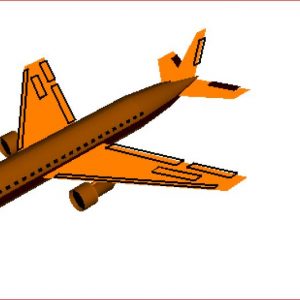
Airplanes are transportation devices which are designed to move people and cargo from one place to another. Airplanes come in many different shapes and sizes depending on the mission of the aircraft. The airplane shown on this slide is a turbine-powered airliner which has been chosen as a representative aircraft. The fuselage, or body of the airplane, is a long hollow … Read the rest ⇢
An important property of any gas is its density. Density is defined as the mass of an object divided by its volume, and most of our experiences with density involve solids. We know that some objects are heavier than other objects, even though they are the same size. A brick and a loaf of bread are about the … Read the rest ⇢
The Animated Gas Lab is a series of computer animations that demonstrate all the possible combinations of the ideal gas law or equation of state. Gases have various properties which we can observe with our senses, including the gas pressure, temperature, mass, and volume which contains the gas. Careful, scientific observation has determined that these variables … Read the rest ⇢
An important property of any gas is its pressure. We have some experience with gas pressure that we don’t have with properties like viscosity and compressibility. Every day we hear the TV meteorologist give the value of the barometric pressure of the atmosphere (29.8 inches of mercury, for example). And most of us have blown up a balloon … Read the rest ⇢
Fluid dynamics involves the interactions between an object and a surrounding fluid, a liquid, or a gas. Fluid dynamics play a major role in the development of thrust in a rocket engine, and in the generation of aerodynamic drag for flight within the atmosphere. To better understand these interactions, we need to know some things about gases. All matter is made … Read the rest ⇢
An important property of any gas is temperature. We have some experience with temperature that we don’t have with properties like viscosity and compressibility. We’ve heard the TV meteorologist give the daily value of the temperature of the atmosphere (15 degrees Celsius, for example). We know that a hot object has a high temperature, and a cold object has a … Read the rest ⇢
Thrust is the force which moves any aircraft through the air. Thrust is generated by the propulsion system of the aircraft. Different propulsion systems develop thrust in different ways, but all thrust is generated through some application of Newton’s third law of motion. For every action there is an equal and opposite reaction. In any propulsion system, a working fluid is accelerated by … Read the rest ⇢
We live in a world that is defined by three spatial dimensions and one time dimension. Objects move within this domain in two ways. An object translates, or changes location, from one point to another. And an object rotates or changes its attitude. In general, the motion of any object involves both translation and rotation. The translations are in … Read the rest ⇢
The center of gravity is a geometric property of any object. The center of gravity is the average location of the weight of an object. We can completely describe the motion of any object through space in terms of the translation of the center of gravity of the object from one place to another, and the rotation of the object about its center of gravity … Read the rest ⇢
As any object moves through a fluid, the velocity of the fluid varies around the surface of the object. The variation of velocity produces a variation of pressure on the surface of the object as shown by the thin red lines on the figure. Integrating the pressure times the surface area around the body determines … Read the rest ⇢
An important aspect of rocket flight is stability and control of the rocket. Model rockets, stomp rockets, and bottle rockets all use aerodynamic forces to provide some measure of flight stability. But these types of toy rockets do not have any system for flight control. In order to successfully complete its mission, a full-scale rocket … Read the rest ⇢
A glider is a special kind of aircraft that has no engine. Paper airplanes are the most obvious example, but gliders come in a wide range of shapes and sizes. Toy gliders, made of balsa wood or styrofoam, are an excellent way for students to study the basics of aerodynamics. The Wright brothers perfected the … Read the rest ⇢
A glider is a special kind of aircraft that has no engine. Paper airplanes are the most obvious example, but gliders come in a wide range of sizes. Toy gliders, made of balsa wood or Styrofoam, are an excellent way for students to study the basics of aerodynamics. Hang-gliders are piloted aircraft that are launched by leaping off the side of … Read the rest ⇢
A glider is a special kind of aircraft that has no engine. There are many different types of gliders. Paper airplanes are the simplest gliders to build and fly. Balsa wood or Styrofoam toy gliders are an inexpensive vehicle for students to have fun while learning the basics of aerodynamics. Hang-gliders are piloted aircraft having cloth wings and minimal structure. Some hang-gliders look like piloted kites, while others … Read the rest ⇢
Flying model rockets is a relatively safe and inexpensive way for students to learn the basics of forces and the response of vehicles to external forces. Students can also use math techniques learned in high school to determine the performance of the rocket during the flight. On this page we show a simple way to determine the altitude of a model rocket. … Read the rest ⇢
On this slide, we show a picture of a Atlas rocket at the left and a picture of the Space Shuttle at the right. The Atlas rocket was developed in the late 1950’s and used small Vernier rockets on the sides of the missile to provide maneuvering and balance. The Space Shuttle was designed in … Read the rest ⇢
Aerodynamics is the study of forces and the resulting motion of objects through the air.
In the spirit of the Wright Brothers, NASA is using aeronautics technology to provide access to space. These fundamentals and lessons will help you understand their journey of flight.
How are rockets made? The Beginner’s Guide to Rockets will introduce you to the basics behind rocket science.
The scientists and engineers of tomorrow are working to retrace the steps of the Wright Brothers. A half scale replica of the Wright’s 1902 aircraft is being built at the Orono Middle School of Orono, Maine. The aircraft is to be used as a traveling exhibit, an educational tool, and eventually as a fixed exhibit … Read the rest ⇢
This is a computer drawing of one cylinder of the Wright brothers’ 1903 aircraft engine. This engine powered the first, heavier than air, self-propelled, maneuverable, piloted aircraft; the Wright 1903 Flyer. The engine consisted of four cylinders like the one shown above, with each piston connected to a common crankshaft which turns the propellers to produce thrust. The brothers’ design is very simple by … Read the rest ⇢
The Zeroth Law of Thermodynamics introduces the concept of thermodynamic equilibrium, in which two objects have the same temperature. If we bring two objects that are initially at different temperatures into physical contact, they will eventually achieve thermal equilibrium. During the process of reaching thermal equilibrium, heat is transferred between the objects. The amount of heat transferred is proportional to the … Read the rest ⇢
Thermodynamics is a branch of physics that deals with the energy and work of a system. Thermodynamics deals only with the large scale response of a system that we can observe and measure in experiments. In rocket science, we are most interested in the thermodynamics of propulsion systems and high speed flows. The Zeroth Law of Thermodynamics introduces the concept of thermodynamic equilibrium, in … Read the rest ⇢
With this software you can investigate how a baseball flies through the air by changing the values of the factors that affect the aerodynamic forces on the ball. These are the same forces that generate the drag of an aircraft wing. The flight trajectory is determined by the initial velocity and the relative size of the drag and weight of the ball. We provide a page of results which … Read the rest ⇢
With this simulator you can investigate how a baseball flies through the air by changing the values of the factors that affect the aerodynamic forces on the ball. These are the same forces that generate the drag of an aircraft wing. The flight trajectory is determined by the initial velocity and the relative size of the drag and weight of the ball. We provide a page … Read the rest ⇢
With this simulator you can investigate how a baseball flies through the air by changing the values of the factors that affect the aerodynamic forces on the ball. These are the same forces that generate the drag of an aircraft wing. The flight trajectory is determined by the initial velocity and the relative size of the drag and weight of the ball. We provide a page … Read the rest ⇢
An important mathematical concept is the idea of function – the value of one variable in a problem depends uniquely on the value of another variable in the problem. Changing the value of one variable produces a change in the value of the other variable that is exactly the same every time you change the first variable. … Read the rest ⇢
All that is necessary to create lift is to turn a flow of air. The airfoil of a wing turns a flow, but so does a spinning ball. The exact details are fairly complex and are given on a separate slide. Summarizing the results, the amount of force generated by a spinning ball depends on the amount of spin, the velocity of the … Read the rest ⇢
All that is necessary to create lift is to turn a flow of air. The airfoil of a wing turns a flow, and so does a rotating cylinder. A spinning ball also turns a flow and generates an aerodynamic lift force. The details of how a spinning ball creates lift are fairly complex. Next to any surface, the molecules of the air stick to the … Read the rest ⇢
All that is necessary to create lift is to turn a flow of air. The airfoil of a wing turns a flow, and so does a rotating cylinder. A spinning ball also turns a flow and generates an aerodynamic lift force. The details of how a spinning ball creates lift are fairly complex. Next to any surface, the molecules of the air stick to the … Read the rest ⇢
The forces on a rocket change dramatically during a typical flight. During powered flight, the propellants of the propulsion system are constantly being exhausted from the nozzle. As a result, the weight and mass of the rocket is constantly changing. Because of the changing mass, we cannot use the standard form of Newton’s second law … Read the rest ⇢
As a wing moves through the air, the airfoil is inclined to the flight direction at an angle. The angle between the chord line and the flight direction is called the angle of attack and has a large effect on the drag generated by the wing. The magnitude of the drag generated by an object depends on the shape of the object and how it … Read the rest ⇢
There are many factors which influence the amount of aerodynamic drag which a body generates. Drag depends on the shape, size, and inclination, of the object, and on flow conditions of the air passing the object. For a three-dimensional wing, there is an additional component of drag, called induced drag, which will be discussed on this … Read the rest ⇢
This is a computer drawing of one cylinder of the Wright brothers’ 1903 aircraft engine. This engine powered the first, heavier than air, self-propelled, maneuverable, piloted aircraft; the Wright 1903 Flyer. The engine consisted of four cylinders like the one shown above, with each piston connected to a common crankshaft which turns the propellers to produce thrust. The brothers’ design is very simple by … Read the rest ⇢
As gas is forced through a tube, the gas molecules are deflected by the walls of the tube. If the speed of the gas is much less than the speed of sound of the gas, the density of the gas remains constant and the velocity of the flow increases. However, as the speed of the … Read the rest ⇢
With this simulation you can investigate how a turbojet or rocket nozzle produces thrust by changing the values of different factors that affect thrust. By changing the shape of the nozzle and the flow conditions upstream and downstream, you can control both the amount of gas that passes through the nozzle and the exit velocity. … Read the rest ⇢
Our Wright 1900 replica weighs 60 pounds. For our full scale replica of the Wright 1900 aircraft, we have a wing area of 170 square feet. We are going to fly the aircraft at the NASA Glenn hangar which is 700 feet above sea level, so the air density is near the standard .00237 slugs/cubic … Read the rest ⇢
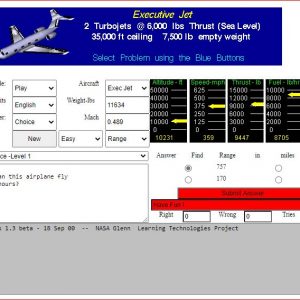
Over twenty years ago, NASA Glenn Research Center developed this collection of interactive simulation exercises to accompany our Beginners Guide to Aeronautics educational content. Students and others in academia, industry, and those with an interest in aeronautics, visit these pages daily to learn and refresh their knowledge of these concepts. Thousands of educators use this … Read the rest ⇢
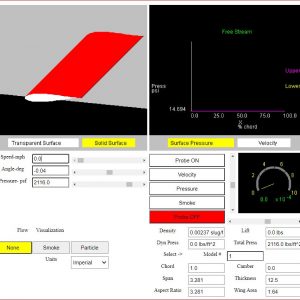
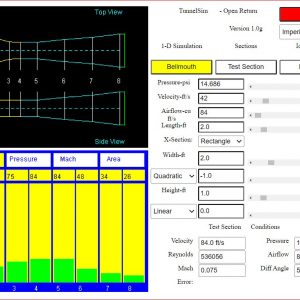
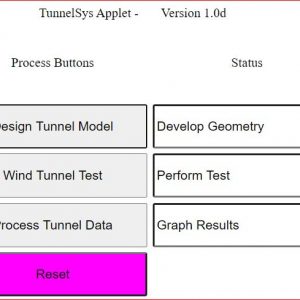
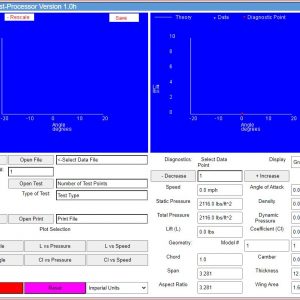
With this simulation you can investigate the process of wind tunnel testing by changing the conditions of a test of a representative wing model. You can look at surface pressure distributions, probe the flow field, and use several flow visualization techniques. TunnelSys is a Java application that students can use to explore the process of … Read the rest ⇢
The Wright brothers used a gasoline powered, four-stroke, internal combustion engine to power their aircraft. In an internal combustion engine, fuel and air are ignited inside a cylinder. The hot exhaust gas pushes a piston in the cylinder which is connected to a crankshaft to produce power. The burning of fuel is not a continuous … Read the rest ⇢
Thermodynamics is a branch of physics which deals with the energy and work of a system. Thermodynamics deals only with the large-scale response of a system which we can observe and measure in experiments. In rocket science, we are most interested in thermodynamics for the role it plays in engine design and high-speed flows. On … Read the rest ⇢
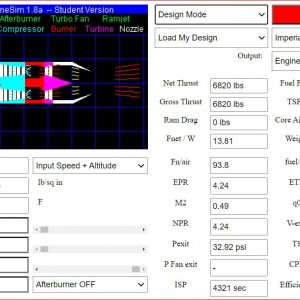
With this simulation you can investigate how a jet (or turbine) engine produces thrust by interactively changing the values of different engine parameters. This program is designed to be interactive, so you have to work with the program. There are several different types of widgets that you use to work with the program. There are a variety of … Read the rest ⇢
Gases can be studied by considering the small-scale action of individual molecules or by considering the large-scale action of the gas as a whole. We can directly measure, or sense, the large-scale action of the gas. But to study the action of the molecules, we must use a theoretical model. The model, called the kinetic … Read the rest ⇢
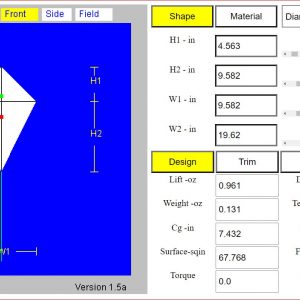
Please note: the simulation below is best viewed on a desktop computer. It may take a few minutes for the simulation to load. With this software you can study the physics and math which describe the flight of a kite. You can choose from several types of kites and change the shape, size, and materials to … Read the rest ⇢
Lift is the force that holds an aircraft in the air. Lift can be generated by any part of the airplane, but most of the lift on an airplane is generated by the wings. There are many explanations for the generation of lift found in encyclopedias, in basic physics textbooks, and on Web sites. Unfortunately, many of … Read the rest ⇢
At the end of the summer of 1901, the Wright brothers were frustrated by the flight tests of their 1901 glider. The aircraft was flown frequently up to 300 feet in a single glide. But the aircraft did not perform as well as the brothers had expected. The aircraft only developed 1/3 of the lift which … Read the rest ⇢
During the fall of 1901, the brothers began to question the aerodynamic data on which they were basing their aircraft designs. They decided to conduct a series of wind tunnel tests to verify the results they were experiencing in flight. They would measure the aerodynamic lift and drag on small models of their wing designs using a wind tunnel in their bicycle shop in Dayton, Ohio. They built … Read the rest ⇢
The lift coefficient is a number that aerodynamicists use to model all of the complex dependencies of shape, inclination, and some flow conditions on lift. This equation is simply a rearrangement of the lift equation where we solve for the lift coefficient in terms of the other variables. The lift coefficient Cl is equal to the lift L divided by the quantity: density rho (\(\bf\rho\)) times half the velocity V squared times … Read the rest ⇢
The lift coefficient is a number that engineers use to model all of the complex dependencies of shape, inclination, and some flow conditions on lift. This equation is simply a rearrangement of the lift equation where we solve for the lift coefficient in terms of the other variables. The lift coefficient Cl is equal to the lift L divided by the quantity: density rho (\(\bf\rho\)) times half the velocity … Read the rest ⇢
Lift depends on the density of the air, the square of the velocity, the air’s viscosity and compressibility, the surface area over which the air flows, the shape of the body, and the body’s inclination to the flow. In general, the dependence on body shape, inclination, air viscosity, and compressibility are very complex. One way to deal with complex dependencies is to characterize the dependence by a single … Read the rest ⇢
Lift depends on the density of the air, the square of the velocity, the air’s viscosity and compressibility, the surface area over which the air flows, the shape of the body, and the body’s inclination to the flow. In general, the dependence on body shape, inclination, air viscosity, and compressibility is very complex. One way to deal with complex dependencies is to characterize the dependence by a single variable. … Read the rest ⇢
Between 1900 and 1905, the Wright brothers designed and built three unpowered gliders and three powered aircraft. As they designed each aircraft, how did they know how big to make the wings? The Wright brothers operated a bicycle shop in Dayton, Ohio, and had a good working knowledge of math and science. They knew about Newton’s laws of motion and about forces and torques. … Read the rest ⇢
Lift can be generated by a wide variety of objects, including airplane wings, rotating cylinders, spinning balls, and flat plates. Lift is the force that holds an aircraft in the air. Lift can be generated by any part of the airplane, but most of the lift on a normal airliner is generated by the wings. How is lift generated? Lift is a force. … Read the rest ⇢
As an object moves through the air, the air is disturbed by the object. The disturbance generates an aerodynamic force on the object. Since a force is a vector quantity, having both a magnitude and a direction, we can split the aerodynamic force into two components. Drag acts in the direction of travel of the object. Lift acts perpendicular to the direction of travel. … Read the rest ⇢
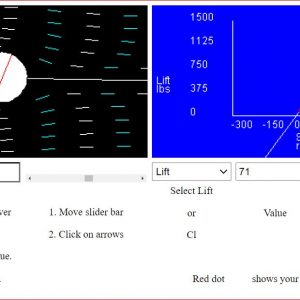
Let’s investigate the lift of a rotating cylinder by using a Java simulator. Please note: the simulation below is best viewed on a desktop computer. It may take a few minutes for the simulation to load. The left window shows an edge view of a cylinder placed in a flow of air. The cylinder is … Read the rest ⇢
This slide shows the balance of forces on a descending Wright 1902 glider. The flight path of the glider is along the thin black line, which falls to the left. The flight path intersects the horizontal, thin, red line at an angle “a” called the glide angle. The tangent of the glide angle, tan(a), is equal to the vertical height … Read the rest ⇢
There are four forces that act on an aircraft in flight: lift, weight, thrust, and drag. Forces are vector quantities having both a magnitude and a direction. The motion of the aircraft through the air depends on the relative magnitude and direction of the various forces. The weight of an airplane is determined by the size and materials used in the airplane’s construction … Read the rest ⇢
On this page, we show a schematic of a liquid rocket engine. Liquid rocket engines are used on the Space Shuttle to place humans in orbit, on many un-manned missiles to place satellites in orbit, and on several high-speed research aircraft following World War II. In a liquid rocket, stored fuel and stored oxidizer are … Read the rest ⇢
This is a computer drawing of the lubrication system of the Wright brothers’ 1903 aircraft engine. This engine powered the first, heavier than air, self-propelled, maneuverable, piloted aircraft; the Wright 1903 Flyer at Kitty Hawk, North Carolina, in December 1903. To generate thrust for their aircraft, the brothers used twin, counter-rotating propellers at the rear of … Read the rest ⇢
Mars is the fourth planet from the Sun and orbits the Sun at an average distance of approximately 141 million miles (225 million km). It rotates on its axis, completing one revolution every 24.6 hours. The axis of Mars is tilted at 25 degrees and 12 minutes relative to its orbital plane about the Sun. … Read the rest ⇢
The Martian atmosphere is an extremely thin sheet of gas, principally carbon dioxide, that extends from the surface of Mars to the edge of space. The Martian atmosphere is less dense than the Earth’s atmosphere, but there are many similarities. Gravity holds the atmosphere to the Martian surface. Within the atmosphere, very complex chemical, thermodynamic, and fluid dynamics effects occur. The atmosphere is not uniform; fluid properties … Read the rest ⇢
The Martian atmosphere is an extremely thin sheet of gas, principally carbon dioxide, that extends from the surface of Mars to the edge of space. The Martian atmosphere is less dense than the Earth’s atmosphere, but there are many similarities. Gravity holds the atmosphere to the Martian surface. Within the atmosphere, very complex chemical, thermodynamic, and fluid dynamics effects occur. The atmosphere is not uniform; fluid properties … Read the rest ⇢
The conservation of mass is a fundamental concept of physics. Within some problem domains, the amount of mass remains constant; mass is neither created nor destroyed. The mass of any object is simply the volume that the object occupies times the density of the object. For a fluid (a liquid or a gas) the density, volume, and shape of the object can … Read the rest ⇢
The conservation of mass is a fundamental concept of physics. Within some problem domain, the amount of mass remains constant –mass is neither created nor destroyed. The mass of any object is simply the volume that the object occupies times the density of the object. For a fluid (a liquid or a gas) the density, volume, and shape of the object can all change … Read the rest ⇢
The conservation of mass is a fundamental concept of physics. Within some problem domain, the amount of mass remains constant; mass is neither created nor destroyed. The mass of any object is simply the volume that the object occupies times the density of the object. For a fluid (a liquid or a gas) the density, volume, and shape of the object can … Read the rest ⇢
Weight is the force generated by the gravitational attraction of a planet on the mass of a rocket. It is related to the mass through the weight equation and each part of a rocket has a unique weight and mass. For some problems it is important to know the distribution of weight. But for rocket … Read the rest ⇢
An airplane can cruise at a constant speed and level flight in which the lift is equal to the weight, and the thrust is equal to the drag. Since there is no net external force on the aircraft, the aircraft maintains a constant airspeed, as described by Newton’s first law of motion. The distance that … Read the rest ⇢
An airplane can cruise at a constant speed and level flight in which the lift is equal to the weight, and the thrust is equal to the drag. Since there is no net external force on the aircraft, the aircraft maintains a constant airspeed, as described by Newton’s first law of motion. The distance that the aircraft flies is then given … Read the rest ⇢
Flying model rockets is a relatively safe and inexpensive way for students to learn the basics of forces and the response of vehicles to external forces. Like an airplane, a model rocket is subjected to the forces of weight, thrust, and aerodynamics during its flight. The weight and aerodynamics are determined by the design of the model rocket components. The thrust is provided by a replaceable solid rocket engine which can be … Read the rest ⇢
Flying model rockets is a relatively safe and inexpensive way for students to learn the basics of forces and the response of vehicles to external forces. Like an airplane, a model rocket is subjected to the forces of weight, thrust, and aerodynamics during its flight. The weight and aerodynamics are determined by the design of the model rocket components. The thrust is provided by a replaceable solid rocket engine which can … Read the rest ⇢
Flying model rockets is a relatively inexpensive, fun-filled way for students to learn the basics of forces and the response of a vehicle to external forces. Students can also learn some of the basics of full-scale rocket operation and performance by flying model rockets. Model rocketry is fun, but it can also be dangerous. At … Read the rest ⇢
Weight is the force generated by the gravitational attraction of a planet on the mass of a rocket. Weight is related to the mass through the weight equation and each part of a rocket has a unique weight and mass. For some problems it is important to know the distribution of weight. But for rocket trajectory and stability, we only need to be concerned with … Read the rest ⇢
Flying model rockets is a relatively safe and inexpensive way for students to learn the basics of forces and the response of a vehicle to external forces. Like an airplane, a model rocket is subjected to the forces of weight, thrust, and aerodynamics during its flight. We have laid the rocket on its side and cut a hole in the body tube so that we can see … Read the rest ⇢
Flying model rockets is a relatively safe and inexpensive way for students to learn the basics of forces and the response of a vehicle to external forces. Students can also learn some of the basics of full-scale rocket operation and performance. On this page, we compare and contrast real rockets and model rockets. A model … Read the rest ⇢
Flying model rockets is a relatively safe and inexpensive way for students to learn the basics of forces and the response of vehicles to external forces. Like an airplane, a model rocket is subjected to the forces of weight, thrust, and aerodynamics during its flight. The thrust force is supplied by a small solid rocket engine. There are two main categories of rocket engines: liquid rockets and … Read the rest ⇢
Over a period of 12 years, the Orono Middle School has involved the sixth grade in an aerospace program that was designed by teachers Richard Glueck and Christopher Chilelli to go beyond the state educational standards. Since 1991, sixth graders have annually combined their math and science skills to reproduce faithful, full-size replicas of the … Read the rest ⇢
Between 1900 and 1905, the Wright brothers designed and built three unpowered gliders and three powered aircraft. As part of the design process, they had to make some mathematical estimates of the lift and drag of their vehicles. The Wright brothers were bicycle mechanics and had a good working knowledge of math and science. They knew about Newton’s laws of motion … Read the rest ⇢
The objective of this simulation is to find the flight conditions that produce an aircraft lift greater than the aircraft weight. You will be determining the combination of velocity, angle of attack, and wing area which are necessary for flight. You can check your results for a particular aircraft by comparing with the individual aircraft page to see how the Wrights … Read the rest ⇢
Lift is created by deflecting a flow of air, and drag is generated on a body in a wide variety of ways. From Newton’s second law of motion, the aerodynamic force F on the body is directly related to the change in momentum of the fluid with time t. The fluid momentum is equal to the mass m times the velocity V of the fluid. \(\LARGE F =\frac{d (m * … Read the rest ⇢
The Moon is Earth’s nearest neighbor. It orbits the Earth at an average distance of approximately 240,000 miles (384,000 km). The Moon completes an orbit of the Earth every 27.3 days (approximately 655 hours). The Moon also rotates on its axis. Because of tidal forces, it completes one revolution every 655 hours. So, one “side” … Read the rest ⇢
An object that falls through a vacuum is subjected to only one external force, the gravitational force, expressed as the weight of the object. An object that is moving only because of the action of gravity is said to be free falling and its motion is described by Newton’s second law of motion. With algebra we can solve for the acceleration of a free falling object. The … Read the rest ⇢
Here’s a Java program which solves the reflected shock problem. Please note: the simulation below is best viewed on a desktop computer. It may take a few minutes for the simulation to load. To study the reflected shock problem, push the “Opposed” button on the blue bar at the top. Input to the program is … Read the rest ⇢
On this page we show the three-dimensional unsteady form of the Navier-Stokes Equations. These equations describe how the velocity, pressure, temperature, and density of a moving fluid are related. In the early 1800’s, the equations were derived independently by G.G. Stokes in England and M. Navier in France. The equations are extensions of the Euler Equations and include the effects of viscosity on the … Read the rest ⇢
Sir Isaac Newton first presented his three laws of motion in the “Principia Mathematica Philosophiae Naturalis” in 1686. His third law states that for every action (force) in nature there is an equal and opposite reaction. In other words, if object A exerts a force on object B, then object B also exerts an equal and opposite … Read the rest ⇢
Sir Isaac Newton’s laws of motion explain the relationship between a physical object and the forces acting upon it. Understanding this information provides us with the basis of modern physics.
As an object moves through a gas, the gas molecules are deflected around the object. If the speed of the object is much less than the speed of sound of the gas, the density of the gas remains constant, and the flow of gas can be described by conserving momentum and energy. As the speed … Read the rest ⇢
Ramjets, scramjets, and rockets all use nozzles to accelerate hot exhaust to produce thrust as described by Newton’s third law of motion. The amount of thrust produced by the engine depends on the mass flow rate through the engine, the exit velocity of the flow, and the pressure at the exit of the engine. The values of these three flow variables are all … Read the rest ⇢
Sir Isaac Newton first presented his three laws of motion in the “Principia Mathematica Philosophiae Naturalis” in 1686. His first law states that every object will remain at rest or in uniform motion in a straight line unless compelled to change its state by the action of an external force. When an external force F is applied, the object … Read the rest ⇢
Lift is a force generated by turning a flow. Many different objects can generate a lift force and there many factors which influence the generation of lift. The left window shows a flow of air going by an object. You can select the shape of the object by using the menu button below the window. Just click on the … Read the rest ⇢
As an object moves through a gas, the gas molecules are deflected around the object. If the speed of the object is much less than the speed of sound of the gas, the density of the gas remains constant and the flow of gas can be described by conserving momentum, and energy. As the speed of the object approaches … Read the rest ⇢
With this simulator you can investigate the design and operation of an open return wind tunnel by changing the geometry and flow conditions in the tunnel. This program is designed to be interactive, so you have to work with the program. There are a variety of choices which you must make regarding the display of results by using … Read the rest ⇢
Engineers make mathematical predictions of the performance of any new aircraft as part of the design process. These predictions use the best data and mathematical techniques which are available to the engineer. For our full scale replica of the Wright 1900 aircraft, we have also made mathematical predictions of the aircraft performance. These computations were performed by … Read the rest ⇢
A glider is a special kind of aircraft that has no engine. In flight, a glider has three forces acting on it as compared to the four forces that act on a powered aircraft. Both types of aircraft are subjected to the forces of lift, drag, and weight. The powered aircraft has an engine that generates thrust, while the glider has no thrust. There are many different … Read the rest ⇢
This slide shows the parts of the Wright brothers’ 1903 airplane and their functions. The various parts of the aircraft were designed and perfected over four years of wind tunnel, kite, and glider flight testing, leading to the first self powered, heavier than air, man controlled flight in December of 1903. You can compare the parts and functions of this aircraft with a … Read the rest ⇢
The study of rockets is an excellent way for students to learn the basics of forces and the response of an object to external forces. There are four major components to any full-scale rocket: the structural system, or frame, the payload system, the guidance system, and the propulsion system. On this page we show some types of … Read the rest ⇢
One of the major breakthroughs of the Wright brothers was the ability to control and maneuver their aircraft. The first aircraft to achieve complete control in all three directions was the 1902 aircraft which is shown in this animation. The animation demonstrates the pitch motion of the aircraft. This is characterized by an up and down movement of the aircraft nose. The … Read the rest ⇢
At the rear of the fuselage of most aircraft one finds a horizontal stabilizer and an elevator. The stabilizer is a fixed wing section whose job is to provide stability for the aircraft, to keep it flying straight. The horizontal stabilizer prevents up-and-down, or pitching, motion of the aircraft nose. The elevator is the small moving section at the rear of … Read the rest ⇢
In flight, any rocket will rotate about its center of gravity, a point which is the average location of the mass of the rocket. We can define a three-dimensional coordinate system through the center of gravity with each axis of this coordinate system perpendicular to the other two axes. We can then define the orientation … Read the rest ⇢
This page shows a schematic drawing of a pitot-static tube. Pitot-Static tubes, which are also called Prandtl tubes, are used on aircraft as speedometers. The actual tube on the aircraft is around 10 inches (25 centimeters) long with a 1/2-inch (1 centimeter) diameter. Several small holes are drilled around the outside of the tube and a … Read the rest ⇢
This is a computer drawing of one cylinder of the Wright brothers’ 1903 aircraft engine. This engine powered the first, heavier than air, self-propelled, maneuverable, piloted aircraft; the Wright 1903 Flyer. The engine consisted of four cylinders like the one shown above, with each piston connected to a common crankshaft which turns the propellers to produce thrust. The brothers’ design is very simple by … Read the rest ⇢
This is a computer animation of the power train of the Wright brothers’ 1903 aircraft engine. This engine powered the first, heavier than air, self-propelled, maneuverable, piloted aircraft; the Wright 1903 Flyer, flown at Kitty Hawk, North Carolina, in December 1903. To generate thrust for their aircraft, the brothers used twin, counter-rotating propellers at the rear … Read the rest ⇢
In 2003, the world celebrated the 100th anniversary of the first flight of an airplane by the Wright brothers at Kitty Hawk, North Carolina. While much attention was paid to the events of December 17,1903, it is important to note that the four flights of that day were only one small step in the development of the … Read the rest ⇢
As an object moves through a gas, the gas molecules are deflected around the object. If the speed of the object is much less than the speed of sound of the gas, the density of the gas remains constant, and the flow of gas can be described by conserving momentum and energy. As the speed of the objects … Read the rest ⇢
The Wright brothers used twin-pusher propellers on their powered aircraft between 1903 and 1905. The details of how a propeller generates thrust is very complex, but we can still learn a few of the fundamentals using the simplified momentum theory presented here. This modern theory is slightly different from the theory developed by the Wright’s to design their propellers. On the … Read the rest ⇢
At the rear of the 1903 Wright Flyer one finds a pair of pusher propellers. The propellers are long, thin, twisted pieces of wood which are spun at high speed. The propeller blade is shaped like an airfoil and there is a pressure difference created across the blade because of the motion of the spinning blade. The pressure difference causes large amounts of air to be … Read the rest ⇢
A text only version of this slide is available which gives the standard day values of all of the flow properties. Air is a mixture of gases, 78% nitrogen and 21% oxygen with traces of water vapor, carbon dioxide, argon, and various other components. We usually model air as a uniform (no variation or fluctuation) gas with properties that are … Read the rest ⇢
Air is a mixture of gases, 78% nitrogen and 21% oxygen with traces of water vapor, carbon dioxide, argon, and various other components. We usually model air as a uniform (no variation or fluctuation) gas with properties that are averaged from all the individual components. Any gas has certain properties that we can detect with our senses. The values and … Read the rest ⇢
There are four major components to any full-scale rocket: the structural system, or frame, the payload system, the guidance system, and the propulsion system. The propulsion of a rocket includes all of the parts which make up the rocket engine, the tanks pumps, propellants, power head and rocket nozzle. The function of the propulsion system … Read the rest ⇢
As discussed on the airplane cruise slide, an airplane can maintain a constant speed and level flight, in which the lift is equal to the weight, and the thrust is equal to the drag. Since there is no net external force on the aircraft, the aircraft maintains a constant airspeed as described by Newton’s First Law of Motion. However, if … Read the rest ⇢
With this simulation you must solve problems involved with determining an aircraft’s motion and performance. Please note: the simulation below is best viewed on a desktop computer. It may take a few minutes for the simulation to load. The program screen is divided into four main parts: At the top of the screen, you will see … Read the rest ⇢
Let’s summarize the information necessary to do a preliminary calculation of an aircraft’s range under cruise conditions. We are taking a very simple view of aircraft range – for academic purposes. In reality, calculating the range is a complex problem because of the large number of variables. An aircraft’s flight is not conducted at a … Read the rest ⇢
When an object moves faster than the speed of sound, and there is an abrupt decrease in the flow area, shock waves are generated. Shock waves are very thin regions in the gas where the gas properties change by a large amount. In many flow problems multiple shocks are present. The shocks may intersect with each other and with the … Read the rest ⇢
One of the most confusing concepts for young aerodynamicists is the relative velocity between objects. Aerodynamic forces are generated by an object moving through a gas. A fixed object in still air does not generate aerodynamic forces. (Hot air balloons “lift” because of buoyancy forces, not aerodynamic forces.) To generate lift, an object must move through the … Read the rest ⇢
The scientists and engineers of tomorrow are working to retrace the steps of the Wright Brothers. A scale replica of the Wright’s 1903 aircraft has been built at the Orono Middle School of Orono, Maine. The model aircraft was sent to the International Space Station in the spring of 2003 where it was used by … Read the rest ⇢
The sites and sounds of Huffman Prairie in 1904-1905 are being recreated in Dover, Ohio, in the fall of 2004. Mark Dusenberry has built and flies a historically accurate, full scale replica of the Wright 1905 flyer. In 2003, the world celebrated the 100th anniversary of the first flight of the Wright Brothers’ airplane. The four … Read the rest ⇢
As an object moves through the atmosphere, the gas molecules of the atmosphere near the object are disturbed and move around the object. Aerodynamic forces are generated between the gas and the object. The magnitude of these forces depends on the shape of the object, the speed of the object, the mass of the gas … Read the rest ⇢
Aerodynamic forces are generated and act on a rocket as it flies through the air. Forces are vector quantities having both a magnitude and a direction. The magnitude of the aerodynamic forces depends on the shape, size and velocity of the rocket and some properties of the air through which it flies. By convention, the single aerodynamic force is broken into two components: the drag force which is opposed to the direction of motion, … Read the rest ⇢
As a rocket flies through the air, it both translates and rotates. The rotation occurs about a point called the center of gravity. The center of gravity is the average location of the weight of the rocket. The mass and weight are distributed throughout the rocket, and for some problems, it is important to know the distribution. But for rocket trajectory and maneuvering, we need … Read the rest ⇢
As a model rocket flies through the air, aerodynamic forces act on all parts of the rocket. In the same way that the weight of all the rocket components acts through the center of gravity cg, the aerodynamic forces act through a single point called the center of pressure cp. How do you determine the location … Read the rest ⇢
There are four major components to any full scale rocket; structural system or frame, the payload system, the guidance system, and the propulsion system. The guidance system of a rocket includes very sophisticated sensors, on-board computers, radars, and communication equipment. The guidance system has two main roles during the launch of a rocket; to provide stability for the rocket, and to control the rocket during maneuvers. … Read the rest ⇢
As an additional feature for the Beginner’s Guide to Rockets, we are including a gallery of photographs of rockets used by NASA to launch a variety of payloads into orbit. A few of the photographs are historical and pre-date the establishment of NASA. There are many more rockets in existence than those listed here. The gallery does not include military … Read the rest ⇢
Please note: the simulation below is best viewed on a desktop computer. It may take a few minutes for the simulation to load. This simulation was developed at the NASA Glenn Research Center in an effort to foster hands-on, inquiry-based learning in science and math. RocketModeler is a simulator that models the design and flight … Read the rest ⇢
With this simulator you can investigate how a rocket nozzle produces thrust by changing the values of different factors that affect thrust. By changing the shape of the nozzle, the types of propellants, and the flow conditions upstream and downstream of the nozzle throat, you can control both the amount of gas that passes through the nozzle and the exit velocity. … Read the rest ⇢
The study of rockets is an excellent way for students to learn the basics of forces and the response of an object to external forces. In flight, a rocket is subjected to the forces of weight, thrust, and aerodynamics. On this slide, we have removed the outer “skin” so that we can see the parts … Read the rest ⇢
In flight, any rocket will rotate about its center of gravity, a point which is the average location of the mass of the rocket. We can define a three-dimensional coordinate system through the center of gravity with each axis of this coordinate system perpendicular to the other two axes. We can then define the orientation … Read the rest ⇢
Since we live in a three-dimensional world, it is necessary to control the attitude or orientation of a flying rocket in all three dimensions. In flight, any rocket will rotate about its center of gravity, a point which is the average location of the mass of the rocket. We can define a three-dimensional coordinate system through … Read the rest ⇢
During the flight of a model rocket small gusts of wind or thrust instabilities can cause the rocket to “wobble” or change its attitude in flight. Like any object in flight, a model rocket rotates about its center of gravity cg, shown as a yellow dot on the figure. The rotation causes the axis of … Read the rest ⇢
During the flight of a model rocket small gusts of wind or thrust instabilities can cause the rocket to “wobble” or change its attitude in flight. Like any object in flight, a model rocket rotates about its center of gravity cg, shown as a yellow dot on the figure. The rotation causes the axis … Read the rest ⇢
On this page, we show a schematic of a rocket engine. In a rocket engine, stored fuel and stored oxidizer are ignited in a combustion chamber. The combustion produces great amounts of exhaust gas at high temperatures and pressure. The hot exhaust is passed through a nozzle which accelerates the flow. Thrust is produced according to Newton’s third law of motion. The amount of thrust … Read the rest ⇢
On this page, we show a schematic of a rocket engine. In a rocket engine, stored fuel and stored oxidizer are ignited in a combustion chamber. The combustion produces great amounts of exhaust gas at high temperature and pressure. The hot exhaust is passed through a nozzle which accelerates the flow. Thrust is produced according … Read the rest ⇢
We live in world that is defined by three spatial dimensions and one time dimension. Objects can move within this domain in two ways. An object can translate, or change location, from one point to another. And an object can rotate or change its attitude. In general, the motion of an object involves both translation and rotation. The motion of … Read the rest ⇢
Following the liftoff of a model rocket, it often turns into the wind. This maneuver is called weather cocking and it is caused by aerodynamic forces on the rocket. The term weathercocking is derived from the action of a weathervane which is shown in black at the top of the figure. A weathervane is often found on the roof of … Read the rest ⇢
Weight is the force generated by the gravitational attraction on the rocket. We are more familiar with weight than with the other forces acting on a rocket, because each of us has our own weight which we can measure every morning on the bathroom scale. We know when one thing is heavy and when another … Read the rest ⇢
As an aircraft moves through the air, the air molecules near the aircraft are disturbed and move around the aircraft. If the aircraft passes at a low speed, typically less than 250 mph, it is observed that the density of the air remains constant. For higher speeds, some of the energy of the aircraft goes … Read the rest ⇢
One of the major breakthroughs of the Wright brothers was the ability to control and maneuver their aircraft. The first aircraft to achieve complete control in all three directions was the 1902 aircraft which is shown in this animation. The animation demonstrates the roll motion of the aircraft. This is characterized by an up and down movement of the wing tips. The … Read the rest ⇢
One of the major breakthroughs of the Wright brothers was the ability to control and maneuver their aircraft. Since we live in a three dimensional world, it is necessary to control the attitude, or orientation, of a flying aircraft in all three dimensions. The first aircraft to achieve complete active control was the 1902 glider which is shown on … Read the rest ⇢
At the rear of the fuselage of most aircraft one finds a vertical stabilizer and a rudder. The stabilizer is a fixed wing section whose job is to provide stability for the aircraft, to keep it flying straight. The vertical stabilizer prevents side-to-side, or yawing, motion of the aircraft nose. The rudder is the small moving section at the rear of … Read the rest ⇢
At the rear of the 1903 Wright Flyer one finds a pair of rudders. The rudders are movable surfaces which are controlled by the pilot. This slide shows what happens when the pilot deflects the trailing edge of the rudders. How does changing the rudder angle affect the aircraft? As described on the inclination effects slide, changing the angle of … Read the rest ⇢
Thermodynamics is a branch of physics which deals with the energy and work of a system. Thermodynamics deals only with the large scale response of a system which we can observe and measure in experiments. In aerodynamics, the thermodynamics of a gas obviously plays an important role in the analysis of propulsion systems. The first law of thermodynamics defines … Read the rest ⇢
The drag coefficient is a number which aerodynamicists use to model all of the complex dependencies of drag on shape, inclination, and some flow conditions. The drag coefficient Cd is equal to the drag D divided by the quantity: \(\LARGE C_{d}=\frac{D}{\frac{1}{2}rV^{2}A}\) This slide shows some typical values of the drag coefficient for a variety of shapes. The values shown here were determined experimentally by placing models in … Read the rest ⇢
The drag coefficient is a number which engineers use to model all of the complex dependencies of drag on shape and flow conditions. The drag coefficient Cd is equal to the drag D divided by the quantity: density r times reference area A times one half of the velocity V squared. \(\LARGE C_{d}=\frac{D}{\frac{1}{2}rV^{2}A}\) This page shows some typical values of the drag coefficient for a variety of shapes. The values shown here were determined experimentally by … Read the rest ⇢
Lift is the force which holds an aircraft in the air. From a Newtonian perspective, lift is generated by turning a flow of air. The flow turning creates a downwash from the wing which can be observed in flight. The flow turning that occurs in the creation of lift also creates bound vorticity within the airfoil. For a general shaped airfoil, there is … Read the rest ⇢
Sir Isaac Newton first presented his three laws of motion in the “Principia Mathematica Philosophiae Naturalis” in 1686. His first law states that every object will remain at rest or in uniform motion in a straight line unless compelled to change its state by the action of an external force. When an external force (F) is applied, the object … Read the rest ⇢
The Wright brothers approached aerodynamics in a thorough, practical, experimental way. From their writings, it is evident that they were very concerned about accurately determining the lift and drag of their aircraft. But they were more practical engineers than theoreticians and many of factors which affect lift and drag are better understood today than they … Read the rest ⇢
As a rocket moves through the atmosphere, the gas molecules of the atmosphere near the rocket are disturbed and move around the rocket. Aerodynamic forces are generated between the gas and the rocket. The magnitude of these forces depend on the shape of the rocket, the speed of the rocket, the mass of the gas going by the rocket and on … Read the rest ⇢
This page shows some rules for the simplified motion of an aircraft. By simplified motion we mean that some of the four forces acting on the aircraft are balanced by other forces and that we are looking at only one force and one direction at a time. In reality, this simplified motion doesn’t occur because all of the forces are … Read the rest ⇢
To better understand what the Wright Brothers accomplished and how they did it, it is necessary to use some mathematical ideas from trigonometry, the study of triangles. Most people are introduced to trigonometry in high school, but for the elementary and middle school students, or the mathematically-challenged: There are many complex parts to trigonometry and we … Read the rest ⇢
The amount of drag generated by an object depends on the size of the object. Drag is an aerodynamic force and therefore depends on the pressure variation of the air around the body as it moves through the air. The total aerodynamic force is equal to the pressure times the surface area around the body. Drag is the component of this force along the flight … Read the rest ⇢
The amount of drag generated by an object depends on the size of the object. Drag is an aerodynamic force and therefore depends on the pressure variation of the air around the body as it moves through the air. The total aerodynamic force is equal to the pressure times the surface area around the body. Drag is the component of this force along the flight … Read the rest ⇢
There are many theories of how lift is generated. Unfortunately, many of the theories found in encyclopedias, on web sites, and even in some textbooks are incorrect, causing unnecessary confusion for students. The theory described on this slide is often seen on web sites and in popular literature. The theory is based on the idea that lift is … Read the rest ⇢
In 1899, when Wilbur Wright decided to “add my mite to help on the future worker who will attain final success” in flight, he wrote to the Smithsonian to obtain technical pamphlets on the state of the art in aerodynamics. He and Orville learned that there were mathematical equations which could be used to predict … Read the rest ⇢
On this page, we show a schematic of a solid rocket engine. Solid rocket engines are used on air-to-air and air-to-ground missiles, on model rockets, and as boosters for satellite launchers. In a solid rocket, the fuel and oxidizer are mixed together into a solid propellant which is packed into a solid cylinder. A hole through … Read the rest ⇢
With this simulator you can investigate how sound waves travel through the air. When you become experienced with this simulator and the physical principles behind the program, you can use a sleek version which loads faster on-line and does not include these instructions. As any object moves through the air, the air near the object is … Read the rest ⇢
A glider is a special kind of aircraft that has no engine. In flight, a glider has three forces acting on it as compared to the four forces that act on a powered aircraft. Both types of aircraft are subjected to the forces of lift, drag, and weight. The powered aircraft has an engine that generates thrust, while the glider has no thrust. There are many different … Read the rest ⇢
Thermodynamics is a branch of physics which deals with the energy and work of a system. Thermodynamics deals only with the large scale response of a system which we can observe and measure in experiments. In rocket science, we are most interested in thermodynamics for the role it plays in engine design and high speed flight. On this page we derive … Read the rest ⇢
Thermodynamics is a branch of physics which deals with the energy and work of a system. Thermodynamics deals only with the large-scale response of a system which we can observe and measure in experiments. Like the Wright brothers, we are most interested in thermodynamics for the role it plays in engine design. On this page … Read the rest ⇢
Thrust is the force that moves a rocket through the air. Thrust is generated by the rocket engine through the reaction of accelerating a mass of gas. The gas is accelerated to the rear and the rocket is accelerated in the opposite direction. To accelerate the gas, we need some kind of propulsion system. We will discuss the … Read the rest ⇢
The state of a gas is defined by various properties which we can observe with our senses, including the gas pressure (p), temperature (T), mass (number of moles – m), and volume (V) which contains the gas. It is observed that, if we have a certain amount (mass or volume) of gas present, the value of the temperature and pressure does not depend on the … Read the rest ⇢
Air is a gas, and an important property of any gas is the speed of sound through the gas. Why are we interested in the speed of sound? The speed of “sound” is the speed of transmission of a small disturbance through a medium. Sound itself is a sensation created in the human brain in response to sensory inputs from … Read the rest ⇢
Spoilers are small, hinged plates on the top portion of wings. Spoilers can be used to slow an aircraft, or to make an aircraft descend, if they are deployed on both wings. Spoilers can also be used to generate a rolling motion for an aircraft, if they are deployed on only one wing. This slide shows what happens … Read the rest ⇢
At the rear of the fuselage of most aircraft one finds a horizontal stabilizer and an elevator to provide stability and control of the up-and-down, or pitching, motion of the aircraft nose. On many fighter planes, in order to meet their high maneuvering requirements, the stabilizer and elevator are combined into one large moving surface called a stabilator. Because the stabilator moves, it … Read the rest ⇢
There are four major components to any full scale rocket; the structural system, or frame, the payload system, the guidance system, and the propulsion system. The structural system of a rocket includes all of the parts which make up the frame of the rocket; the cylindrical body, the fairings, and any control fins. The function of the structural system is to transmit the … Read the rest ⇢
Please note: the simulation below is best viewed on a desktop computer. It may take a few minutes for the simulation to load. With this simulator you can investigate how an aircraft wing produces lift and drag by changing the values of different factors that affect lift and the factors that affect drag. This program is designed to be interactive, so you have to … Read the rest ⇢
As an object moves through a gas, the gas molecules are deflected around the object. If the speed of the object is much less than the speed of sound of the gas, the density of the gas remains constant and the flow of gas can be described by conserving momentum, and energy. As the speed … Read the rest ⇢
Here is a JavaScript calculator which will solve the equations presented on this page: Please note: the simulation below is best viewed on a desktop computer. It may take a few minutes for the simulation to load. An object which is falling through the atmosphere is subjected to two external forces. One force is the gravitational force, expressed as the weight of the … Read the rest ⇢
To move any airplane through the air, we must use a propulsion system to generate thrust. Different types of aircraft use different types of propulsion devices, but all aircraft rely on some type of engine to generate the power needed to run the propulsion system. The internal combustion, or piston engine, used by the Wright brothers and the modern jet and rocket engine all … Read the rest ⇢
A glider is a special kind of aircraft that has no engine. There are many different types of glider aircraft. Paper airplanes are the simplest gliders to build and fly. Balsa wood or Styrofoam toy gliders are an inexpensive vehicle for students to have fun while learning the basics of aerodynamics. Hang-gliders are piloted aircraft having cloth wings and minimal structure. Some hang-gliders look like … Read the rest ⇢
A glider is a special kind of aircraft that has no engine. There are many different types of glider aircraft. Paper airplanes are the simplest gliders to build and fly. Balsa wood or Styrofoam toy gliders are an inexpensive vehicle for students to have fun while learning the basics of aerodynamics. Hang-gliders are piloted aircraft having cloth wings and minimal structure. Some hang-gliders look like … Read the rest ⇢
Thrust is the force which moves an aircraft through the air. For the 1903 Wright Flyer, thrust is generated by the propellers of the airplane. What is thrust? Thrust is a mechanical force. It is generated most often through the application of Newton’s third law of motion. A mass of gas (air) is accelerated in one direction by the propulsion system, … Read the rest ⇢
Thrust is the force which moves an aircraft through the air. Thrust is used to overcome the drag of an airplane, and to overcome the weight of a rocket. Thrust is generated by the engines of the aircraft through some kind of propulsion system. Thrust is a mechanical force which is generated through the reaction of accelerating a mass of gas, which acts as a … Read the rest ⇢
On this slide, we have collected all of the equations necessary to calculate the thrust of a rocket engine. In a rocket engine, stored fuel and stored oxidizer are ignited in a combustion chamber. The combustion produces great amounts of exhaust gas at high temperature and pressure. The hot exhaust is passed through a nozzle which accelerates the flow. Thrust is produced according … Read the rest ⇢
There are four forces that act on an aircraft in flight: lift, weight, thrust, and drag. Forces are vector quantities having both a magnitude and a direction. The motion of the aircraft through the air depends on the relative magnitude and direction of the various forces. The weight of an airplane is determined by the size and materials used in the airplane’s construction … Read the rest ⇢
This is a computer drawing of the timing system of the Wright brothers’ 1903 aircraft engine. This engine powered the first, heavier than air, self-propelled, maneuverable, piloted aircraft; the Wright 1903 Flyer at Kitty Hawk, North Carolina, in December, 1903. To generate thrust for their aircraft, the brothers used twin, counter-rotating propellers at the rear of the aircraft. To turn the propellers, the brothers … Read the rest ⇢
A force may be thought of as a push or pull in a specific direction. When a force is applied to an object, the object accelerates in the direction of the force according to Newton’s laws of motion. The object may also experience a rotation depending on how the object is confined and where the force is applied. A hanging door is … Read the rest ⇢
We live in world that is defined by three spatial dimensions and one time dimension. Objects can move within this domain in two ways. An object can translate, or change location, from one point to another. And an object can rotate, or change its attitude. In general, the motion of an aircraft involves both translation and rotation. This makes the analysis … Read the rest ⇢
As described on the forces slide, the aircraft lift is the sum of the lift of all of the parts of the airplane and acts through the aircraft center of pressure. Each part of the aircraft has its own lift component and its own center of pressure. The major part of the lift comes from the wings, but the horizontal stabilizer and elevator also … Read the rest ⇢
A fundamental aircraft motion is a banking turn. This maneuver is used to change the aircraft heading. The turn is initiated by using the ailerons or spoilers to roll, or bank, the aircraft to one side. On the figure, the airliner is banked to the right by lowering the left aileron and raising the right aileron. The lift of the wings of the … Read the rest ⇢
On this page, we show scaled computer drawings of the unpowered aircraft which were built and flown by the Wright brothers between 1900 and 1902. The brothers used these aircraft to learn the basics of aerodynamics and flight control. They often flew these aircraft as kites to determine and verify aircraft performance. The brothers also learned how to fly by … Read the rest ⇢
This slide shows the balance of forces on a descending glider. There are three forces acting on the glider; weight, lift, and drag. Forces are vector quantities having both a magnitude and a direction. The magnitude of the weight is given by the weight equation and depends on the mass of the aircraft and its payload. The direction of the weight is always towards the center … Read the rest ⇢
There are four forces that act on an aircraft in flight: lift, weight, thrust, and drag. The motion of the aircraft through the air depends on the relative size of the various forces and the orientation of the aircraft. For an aircraft in cruise, the four forces are balanced, and the aircraft moves at a constant velocity and altitude. Some modern fighter aircraft can change … Read the rest ⇢
Aerodynamic forces are generated whenever an object moves through a liquid or gas. From Newton’s second law of motion, the aerodynamic forces on the body are directly related to the change in momentum of the fluid with time. The fluid momentum is equal to the mass times the velocity of the fluid. Since the fluid is moving, defining the mass … Read the rest ⇢
Let’s investigate the dependence of lift on velocity using a Java simulator. Please note: the simulation below is best viewed on a desktop computer. It may take a few minutes for the simulation to load. Lift is created by deflecting a flow of air and drag is generated on a body in a wide variety of ways. From … Read the rest ⇢
There are many theories of how lift is generated. Unfortunately, many of the theories found in encyclopedias, on web sites, and even in some textbooks are incorrect, causing unnecessary confusion for students. The theory described on this slide is often seen on web sites and in popular literature. The theory is based on the idea … Read the rest ⇢
Flying model rockets is a relatively safe and inexpensive way for students to learn the basics of forces and the response of a vehicle to external forces. A model rocket is subjected to four forces in flight: weight, thrust, and the aerodynamic forces, lift and drag. There are many different types of model rockets. One of the first and simplest type of rocket that a student encounters is … Read the rest ⇢
Weight is the force generated by the gravitational attraction of one object on another object. The equation which describes the weight of an object is the same equation whether we are studying airplanes, rockets, or rocks. Weight is fundamentally different from the aerodynamic forces, lift and drag, and the thrust force. Aerodynamic forces and thrust are mechanical forces and the object has to be … Read the rest ⇢
Weight is the force generated by the gravitational attraction of the earth on any object. Weight is fundamentally different from the aerodynamic forces, lift and drag. Aerodynamic forces are mechanical forces and the object has to be in physical contact with the air which generates the force. The gravitational force is a field force; the source of the force does not have to be in … Read the rest ⇢
Weight is the force generated by the gravitational attraction of the earth on any object. Weight is fundamentally different from the aerodynamic forces, lift and drag. Aerodynamic forces are mechanical forces and the object has to be in physical contact with the air which generates the force. The gravitational force is a field force; the source of the force does not have to be in physical … Read the rest ⇢
Drag is the aerodynamic force that opposes an aircraft’s motion through the air. Drag is generated by every part of the airplane (even the engines!). How is drag generated? Drag is a mechanical force. It is generated by the interaction and contact of a solid body with a fluid (liquid or gas). It is not generated by a force field, in … Read the rest ⇢
Lift is the force that directly opposes the weight of an airplane and holds the airplane in the air. Lift is generated by every part of the airplane, but most of the lift on a normal airliner is generated by the wings. Lift is a mechanical aerodynamic force produced by the motion of the airplane through the air. Because lift is a force, … Read the rest ⇢
For scientists, power is the rate at which work is performed by a force acting along a distance. As an example shown on the slide, the Wright 1903 aircraft is acted upon by the thrust force (F) from time (t) equals zero to some later time (t > 0) and travels some distance (s). The work (W) done on the aircraft during this time … Read the rest ⇢
Thermodynamics is a branch of physics which deals with the energy and work of a system. It was born in the 19th century as scientists were first discovering how to build and operate steam engines. Thermodynamics deals only with the large scale response of a system which we can observe and measure in experiments. Small … Read the rest ⇢
Thrust is the force which moves an aircraft through the air. Thrust is used to overcome the drag of an airplane, and to overcome the weight of a rocket. Thrust is generated by the engines of the aircraft through some kind of propulsion system. Thrust is a mechanical force, so the propulsion system must be in physical contact with a working fluid to produce thrust. Thrust … Read the rest ⇢
Weight is the force generated by the gravitational attraction of the earth on the airplane. We are more familiar with weight than with the other forces acting on an airplane, because each of us have our own weight which we can measure every morning on the bathroom scale. We know when one thing is heavy and when another thing is … Read the rest ⇢
Flying model rockets is a relatively safe and inexpensive way for students to learn the basics of forces and the response of a vehicle to external forces. Any rocket is subjected to four forces in flight: weight, thrust, and the aerodynamic forces, lift and drag. There are many different types of model rockets. An interesting … Read the rest ⇢
At the end of 1901, the Wright brothers were frustrated by the flight tests of their 1900 and 1901 gliders. The aircraft were flown frequently up to 300 feet in a single glide. But neither aircraft performed as well as predicted using the design methods available to the brothers. Based on their measurements, the 1901 aircraft only developed 1/3 … Read the rest ⇢
At the end of 1901, the Wright brothers were frustrated by the flight tests of their 1900 and 1901 gliders. Neither aircraft performed as well as predicted using the design methods available to the brothers. Based on their measurements, the 1901 aircraft only developed 1/3 of the lift which was predicted by using the Lilienthal … Read the rest ⇢
During the fall of 1901, the brothers began to question the aerodynamic data on which they had based the design of their 1900 and 1901 gliders. They decided to measure their own values of lift and drag with a series of wind tunnel tests. To measure the lift and drag, the brothers built small models of their wing designs and placed them on a measuring device … Read the rest ⇢
Please note: the simulation below is best viewed on a desktop computer. It may take a few minutes for the simulation to load. With this simulator you can investigate the process of wind tunnel testing by changing the conditions of a test of a representative wing model. You can look at surface pressure distributions, probe … Read the rest ⇢
With this simulation you can investigate the design of a wind tunnel model by changing the geometry of a representative wing model. This program is designed to be interactive, so you have to work with the program. There are a variety of choices which you must make regarding the display of results by using a choice … Read the rest ⇢
This slide gives technical definitions of a wing’s geometry, which is one of the chief factors affecting airplane lift and drag. The terminology used here is used throughout the airplane industry today and was mostly known to the Wright brothers in 1900. Actual aircraft wings are complex three-dimensional objects, but we will start with some simple definitions. The figure … Read the rest ⇢
This slide gives technical definitions of a wing’s geometry, which is one of the chief factors affecting airplane lift and drag. The terminology is used throughout the airplane industry and is also found in the FoilSim interactive airfoil simulation program developed here at NASA Glenn. Actual aircraft wings are complex three-dimensional objects, but we will start with some simple definitions. The figure … Read the rest ⇢
One of the major breakthroughs of the Wright brothers was the ability to control and maneuver their aircraft. Roll control was provided by a unique idea called wing warping. The tips of their wings could by twisted relative to the rest of the wing by a series of cables. The mechanics of wing warping is shown with the aircraft fixed in … Read the rest ⇢
There are many factors which influence the amount of aerodynamic drag which a body generates. Drag depends on the shape, size, and inclination, of the object, and on flow conditions of the air passing the object. For a three dimensional wing, there is an additional component of drag, called induced drag, or drag due to lift. Induced drag is a three dimensional effect related to the distribution … Read the rest ⇢
Thermodynamics is a branch of physics which deals with the energy and work of a system. Thermodynamics deals only with the large scale response of a system which we can observe and measure in experiments. As aerodynamicists, we are most interested in the thermodynamics of propulsion systems, which produce thrust by accelerating a gas. To understand how thrust is … Read the rest ⇢
Thermodynamics is a branch of physics which deals with the energy and work of a system. Thermodynamics deals only with the large-scale response of a system which we can observe and measure in experiments. In aerodynamics, we are most interested in the thermodynamics of high speed flows, and in propulsion systems which produce thrust by accelerating a gas. To understand how thrust is … Read the rest ⇢
For scientists, work is the product of a force acting on an object times the distance that the object moves. As an example shown on the slide, the Wright 1903 aircraft is acted upon by the thrust force (F) from time (t) equals zero to some later time (t > 0) and travels some distance (s). The work (W) done on the … Read the rest ⇢
On December 17,1903, at Kitty Hawk North Carolina, the first piloted, controlled, self-propelled, heavier than air craft, the first airplane, was flown by the Wright brothers. It is important to note that the flights of that day were only the culmination of nearly five years of work by the brothers. The process which lead to the … Read the rest ⇢
One of the major breakthroughs of the Wright brothers was the ability to control and maneuver their aircraft. The first aircraft to achieve complete control in all three directions was the 1902 aircraft which is shown in this animation. The animation demonstrates the yaw motion of the aircraft. This is characterized by a side to side movement of the aircraft nose. The … Read the rest ⇢
Thermodynamics is a branch of physics which deals with the energy and work of a system. Thermodynamics deals only with the large-scale response of a system which we can observe and measure in experiments. There are three principal laws of thermodynamics which are described on separate slides. Each law leads to the definition of thermodynamic … Read the rest ⇢