
Similarity Parameters
The Wright brothers approached aerodynamics in a thorough, practical, experimental way. From their writings, it is evident that they were very concerned about accurately determining the lift and drag of their aircraft. But they were more practical engineers than theoreticians and many of factors which affect lift and drag are better understood today than they were by the Wright brothers.
For a more complete understanding, we present here a page which describes the modern theories of viscosity and compressibility effects on any moving object. The Wright aircraft were certainly subjected to viscous effects, since this causes boundary layer separation and wing stall, which the brothers experienced in flight, and has a large effect on overall aircraft drag. Fortunately, the Wright aircraft flew at very low velocities and were not subject to compressibility effects.
Aerodynamic Forces
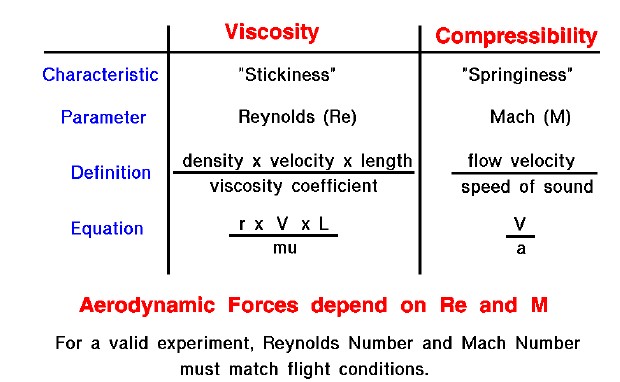
As an object moves through air or gas, the air or gas molecules near the object are disturbed and moved around the object. Aerodynamic forces are generated between the air or gas and the object. The magnitude of these forces depends on the shape of the object, the speed of the object, the mass of the gas or air going by the object and on two other important properties of the air, the viscosity, or stickiness, of the air and the compressibility, or springiness, of the air.
Moving forward, to clarify the terminology, “air” or “gas” will be used interchangeably depending on the specific context.
Similarity Parameter
To properly model these effects, aerodynamicists use similarity parameters, which are ratios of these effects to other forces present in the problem. If two experiments have the same values for the similarity parameters, then the relative importance of the forces are being correctly modeled. Representative values for the properties of air are given on another page, but the actual value of the parameter depends on the state of the gas and on the altitude.
Boundary Layer
Aerodynamic forces depend in a complex way on the viscosity of the air. As an object moves through the air, the air molecules stick to the surface. This creates a layer of air near the surface (called a boundary layer) which, in effect, changes the shape of the object. The flow turning reacts to the boundary layer just as it would to the physical surface of the object. To make things more confusing, the boundary layer may lift off or “separate” from the body and create an effective shape much different from the physical shape. And to make it even more confusing, the flow conditions in and near the boundary layer are often unsteady (changing in time). The boundary layer is very important in determining the drag of an object. To determine and predict these conditions, aerodynamicists rely on wind tunnel testing and very sophisticated computer analysis.
Reynolds Number
The important similarity parameter for viscosity is the Reynolds number. The Reynolds number expresses the ratio of inertial (resistant to change or motion) forces to viscous (heavy and gluey) forces. From a detailed analysis of the momentum conservation equation, the inertial forces are characterized by the product of the density rho (\(\bf\rho\)) times the velocity V times the gradient of the velocity dV/dx. The viscous forces are characterized by the viscosity coefficient mu (\(\bf\mu\)) times the second gradient of the velocity d2V/dx2. The Reynolds number Re then becomes:
\(\LARGE \mathit{Re}=\frac{\rho V\frac{\text{d}V}{\text{d}x}}{\mu\frac{\text{d}^{2}V}{\text{d}x^{2}}}\)
\(\LARGE \mathit{Re}=\frac{\rho VL}{\mu}\)
where L is some characteristic length of the problem. If the Reynolds number of the experiment and flight are close, then we properly model the effects of the viscous forces relative to the inertial forces. If they are very different, we do not correctly model the physics of the real problem and predict incorrect levels of the aerodynamic forces.
Further Complexities in Launches
Aerodynamic forces also depend in a complex way on the compressibility of the air. As an object moves through the air, the air molecules move around the object. If the object passes at a low speed (typically less than 200 mph) the density of the fluid will remain constant. But for high speeds, some of the energy of the object goes into compressing the fluid and changing the density, which will alter the amount of resulting force on the object. This effect becomes more important as speed increases. Near and beyond the speed of sound (about 330 m/s or 700 mph), shock waves are produced that affect both the lift and drag of an object. Again, aerodynamicists rely on wind tunnel testing and sophisticated computer analysis to predict these conditions.
Mach Number
The important similarity parameter for compressibility is the Mach number – M, the ratio of the velocity of the rocket to the speed of sound a.
\(\LARGE M=\frac{V}{a}\)
So it is completely incorrect to measure a drag coefficient at some low speed (say 200 mph) and apply that drag coefficient at twice the speed of sound (approximately 1400 mph, Mach = 2.0). The compressibility of the air alters the important physics between these two cases.
The effects of compressibility and viscosity on drag are contained in the drag coefficient. For propulsion systems, compressibility affects the amount of mass that can pass through an engine and the amount of thrust generated by a rocket nozzle.